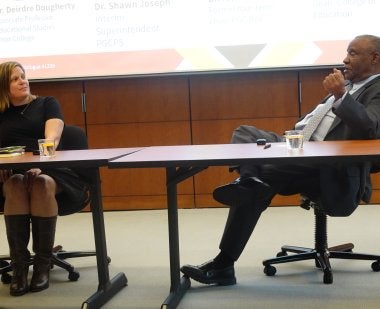
On April 13, the University of Maryland Center for Community Engagement, in partnership with the College of Education, the Maryland Democracy Initiative, the Center for Educational Innovation and Improvement (CEii) and Prince George’s County Public Schools (PGCPS) hosted a dynamic conversation in UMD’s Anacostia Building about the history and legacy of school desegregation in Prince George’s County.
Deirdre Mayer Dougherty’s recent book “Race and Place: School Desegregation in Prince George’s County, Maryland” served as the jumping-off point for the conversation. Dougherty discussed her book, which traces a series of desegregation policies in the county between 1945 to 1973 and how they impacted the experiences of community members. Dougherty began her career as a seventh grade language arts teacher in Prince George’s County and is now an associate professor of educational studies at Knox College in Galesburg, Illinois.
“My research revealed that before and after the [Supreme Court’s 1954 Brown v. Board of Education] decision, in every moment, leaders in the majority white district [of Prince George’s County] at that time were acting on behalf of white students, mostly through resisting and complying unevenly with federal law. And at every moment, Black families, teachers and communities were seeking something different: access to education on equal terms,” said Dougherty. “Sometimes it meant defending the closure of Black schools. At other moments, it meant sending their children across town. And these ideas about the best way of guaranteeing public education on equal terms changed over time.”
“Desegregation as a set of policies has a complicated history,” she continued. “Desegregation resulted in large part in the displacement of Black professionals, the closure of historically Black schools, the transportation of Black children into hostile white schools, and a disconnect between schooling and community. Also, desegregation measures were mostly controlled by white politicians.”
Following Dougherty’s presentation, Segun Eubanks Ed.D. ’12, director of CEii and professor of practice at the College of Education, facilitated a conversation among educational leaders including Dougherty; Alvin Thornton, former four-term chair of the Prince George’s County Board of Education; Shawn Joseph, interim superintendent for PGCPS; and Kimberly Griffin M.A. ’01, dean of the College of Education. The leaders reflected on the lessons of desegregation and the ongoing work toward building equitable schools today.
Thornton discussed his work on the Commission on Education Finance, Equity and Excellence (1999-2002), known as the Thornton Commission, which represented a turning point for equitable school funding in Maryland. During the conversation, Thornton advocated for funding today’s Blueprint for Maryland’s Future and discussed societal barriers that continue to impede equity.
“Segregatedness of schools reflects segregated communities,” said Thornton. “Until we create income balance and until we get our cultural institutions, religious institutions and institutions of education to create a cultural situation where people want to live together, then we’re going to chase after a moving target.”
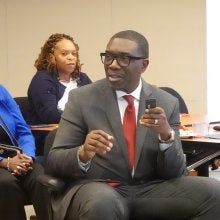
Joseph described current efforts to advance equity in PGCPS. He remarked that the district needs to move from pockets of excellence to excellence at scale and noted that equitable outcomes require equitable investments.
“We recognize that if you’re going to lead for social justice, step one, you’ve got to understand the history. How did we get here? And acknowledge that here is not where we want to be,” said Joseph. “Step two, what are going to be your reversal strategies? What policies? How are you going to put the limited resources you have on those things that will have the greatest impact? Then step three is redistribution. How do you figure out what works [and] how to scale it?”
At the conclusion of the event, Griffin reflected on the ongoing implications of segregation and desegregation and the path forward. “There’s a required structural undoing of what has been done, and that undoing must be collaborative,” she said. “This is a community project, and we all need to be engaged in this work together as decision makers and policy makers.”
Top photo: Deirdre Mayer Dougherty and Alvin Thornton