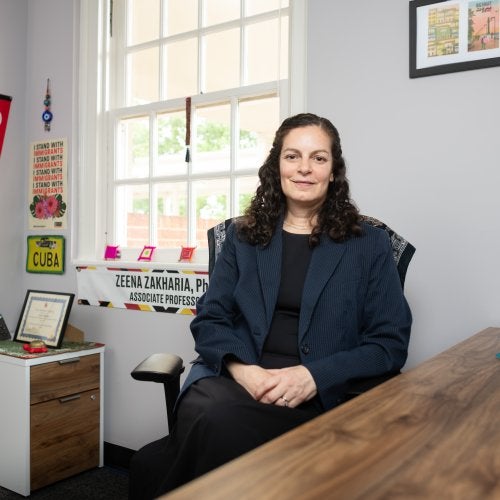
Candice Love wants to harness the power of play to help children learn math concepts without stress or fear. “Mathematics is generally considered a space that is unsafe and exclusionary for a lot of people,” says Love, a Presidential Postdoctoral Fellow in the University of Maryland College of Education. “I’m interested in reclaiming that narrative and assessing how play can allow students to encounter mathematics in different ways.”
According to a study Love led, which was recently published in the Journal of Research in Childhood Education, playful approaches can promote kindergarten students’ understanding of math concepts and inject a social dimension that reinforces learning. According to Love, who uses they/them pronouns, learning through play from peers, rather than an instructor, is “a completely different dynamic, and, depending on the kid and the situation, it may be more powerful.”
For the study, Love and their co-authors, Amy Parks, a professor at Michigan State University, and Madison Knowe, formerly a postdoctoral researcher at Vanderbilt University, followed a class of 26 kindergarteners while they worked with their teacher to introduce a play-centered approach to understanding geometric concepts and compare it with whole-class teaching.
During whole-class lessons, the teacher — referred to in the study as Ms. Lane — led a 10- to 20-minute discussion while children listened and raised their hands to interact.
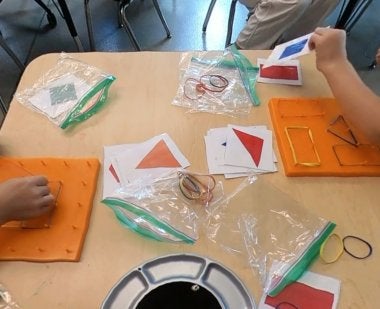
By contrast, in play-centered sessions, kids were given flat “geoboards” with pegs, on which they could use rubber bands to create shapes. After explaining common geometric terms, Ms. Lane let the kids play with their geoboards while she roamed the classroom offering support. The children looked at cards showing shapes and tried to reproduce the shapes while chatting with their peers.
After analyzing 15 videos of the class taken over four days, the researchers found students were more actively engaged in learning during guided-play contexts. For example, the kids asked 20 questions during the geoboard activity — directed at both their teacher and other students — while no children asked questions in whole-class sessions. In addition, during guided play, “they were able to test their ideas with one another to come up with truths about mathematics on their own,” says Love, who taught elementary school for several years before starting their dissertation assessing how Division 1 basketball players incorporate math into the game.
Ms. Lane observed striking differences as well, noting that the students relied on her more for guidance in whole-class discussions. During play-centered learning, however, “they naturally talked with one another, shared strategies, solved problems together and used trial-and-error without waiting for me to provide the answer,” she says. “My role shifted from being the primary source of information to being an observer, facilitator and supporter of their mathematical thinking.”
In fact, Ms. Lane noticed some of her quiet students were more willing to participate when engaged in math play. “This experience changed my approach to teaching math by helping me see the value of allowing children more time and space to explore mathematical ideas through play and discovery,” she adds.
Play-centered techniques like the one in Love’s study are designed to incorporate a multiplicity of voices into learning. Research indicates such approaches can bolster kids’ confidence and make material more relatable.
According to Love, one reason play-focused learning isn’t more common is the pressure educators feel to adopt predictable teaching methods focused on improving test scores. But that may shift, given that the American Academy of Pediatrics and others have recently highlighted the importance of recess and play in childhood development.
“I’m not saying that instructors should never teach anything as a collective group,” Love says. “But we have to also think about, when is that the most productive mode of instruction and when is allowing kids to play?”