

Supporting inclusive classroom Practices, Interventions, Research, and Leadership (SPIRAL)
Scholarly Works

The new and fully revised second edition of Enduring Issues in Special Education is aimed at any course in the undergraduate or graduate special education curriculum that is wholly or partly devoted to a critical examination of current issues in special education. As we approach a decade since the original edition was published, the second edition includes an analysis of newly developed and historical issues written by leading experts in the field of education.
The book’s objective, in addition to informing readers about the issues, is to ask readers to consider critical questions related to each issue. The book organizes 30 chapters into seven sections using the same structuring principles as the first edition—what, why, who (students and professionals), where, and how (now and in the future). Like the first edition, each chapter includes the authors' personal perspectives, suggested resources, and discussion questions. A core addition is a section on the future of special education research, practice, preparation, and policy.
Lemons, C. J., Weiss, P., & Hirsch, S. E. (2026). Enduring Issues in Special Education: Personal Perspectives, Second Edition. Routledge. https://doi.org/10.4324/9781003495215
Elementary Educators’ Integration of Universal Design for Learning in Data Science
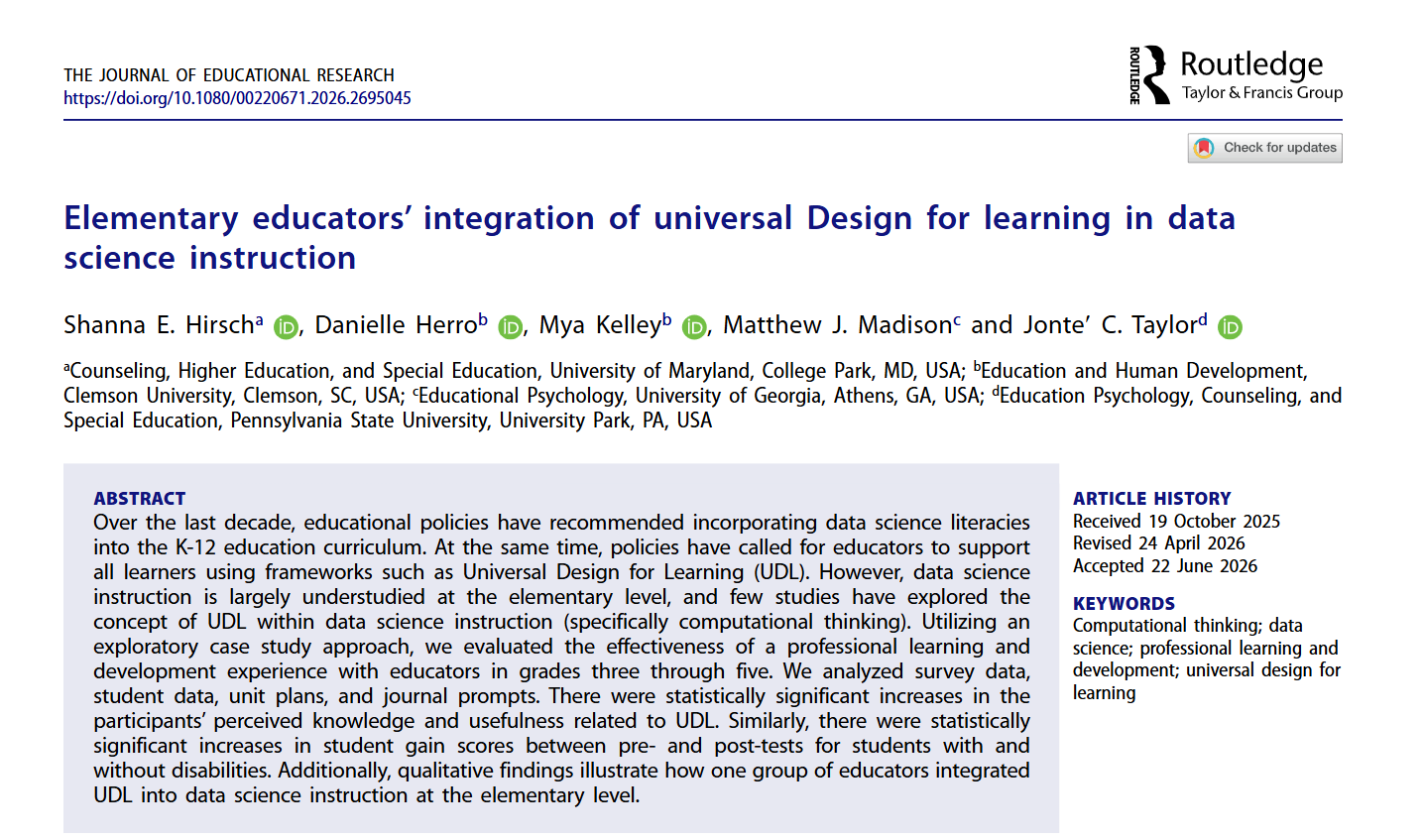
Instruction
Over the last decade, educational policies have recommended incorporating data science literacies into the K-12 education curriculum. At the same time, policies have called for educators to support all learners using frameworks such as Universal Design for Learning (UDL). However, data science instruction is largely understudied at the elementary level, and few studies have explored the concept of UDL within data science instruction (specifically computational thinking). Utilizing an exploratory case study approach, we evaluated the effectiveness of a professional learning and development experience with educators in grades three through five.
Hirsch, S. E., Herro, D., Kelley, M., Madison, M., & Taylor, J. (2026). Elementary teachers’ understanding and implementation of UDL practices in data science instruction. The Journal of Educational Research. https://doi.org/10.1080/00220671.2026.2695045
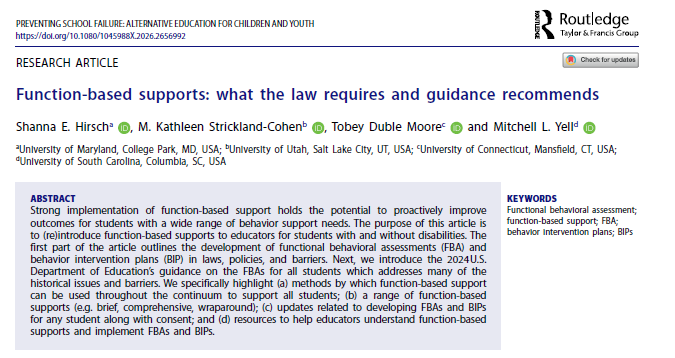
Function-based Supports: What the Law Requires and Guidance Recommends
Strong implementation of function-based support holds the potential to proactively improve outcomes for students with a wide range of behavior support needs. The purpose of this article is to (re)introduce function-based supports to educators for students with and without disabilities. The first part of the article outlines the development of functional behavioral assessments (FBA) and behavior intervention plans (BIP) in laws, policies, and barriers. Next, we introduce the 2024 U.S. Department of Education’s guidance on the FBAs for all students which addresses many of the historical issues and barriers. We specifically highlight (a) methods by which function-based support can be used throughout the continuum to support all students; (b) a range of function-based supports (e.g. brief, comprehensive, wraparound); (c) updates related to developing FBAs and BIPs for any student along with consent; and (d) resources to help educators understand function-based supports and implement FBAs and BIPs.
Hirsch, S. E., Strickland-Cohen, K., Duble Moore, T., & Yell, M. L. (2026). Function-based supports: What the law requires and guidance recommends. Preventing School Failure. http://dx.doi.org/10.1080/1045988X.2026.2656992
Developing Impactful Professional Learning Experiences for Special Educators Through a Community of Practice Lens
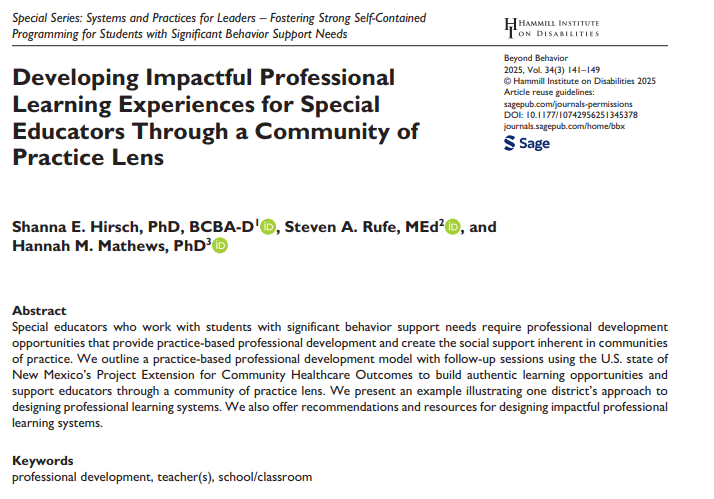
Special educators who work with students with significant behavior support needs require professional development opportunities that provide practice-based professional development and create the social support inherent in communities of practice. We outline a practice-based professional development model with follow-up sessions using the U.S. state of New Mexico’s Project Extension for Community Healthcare Outcomes to build authentic learning opportunities and support educators through a community of practice lens. We present an example illustrating one district’s approach to designing professional learning systems. We also offer recommendations and resources for designing impactful professional learning systems.
Hirsch, S. E., Rufe, S., & Mathews, H. M. (2025). Developing impactful professional learning experiences for special educators through a community of practice lens. Beyond Behavior. doi.org/10.1177/10742956251345378
Preparing the Next Generation of Educators to Implement Classroom Positive Behavioral Interventions and Supports
The role of an educator is complex. Their job requires them to be efficient and effective teachers across academic subjects (Archer & Hughes, 2011). Furthermore, all educators must know how to support students’ social-emotional and behavioral well-being (U.S. Department of Education, 2021). Together, these fundamental practices support Meehan’s quote “A well prepared and engaging teacher is a catalyst” (Meehan, n.d.). This parsimonious statement captures the essence of teaching, yet it does not capture the complexities (i.e., how to create positive student learning environments).
Hirsch, S. E., Kelley, M., & Qualls, L. W. (2025). Preparing the next generation of educators to implement classroom positive behavior interventions and supports. In T. J. Lewis, B. Simonsen, K. McIntosh, and H. P. George (Eds.), Handbook of positive behavior supports, Second Edition. Springer. https://doi.org/10.1007/978-3-031-96102-1_18
Hirsch, S. E., Lewis, T. J., & Bruhn, A. L. (2024). Embedded HLP 10: Conduct functional behavioral assessment to develop individual student behavior support plans. In T. C. Aceves & M. J. Kennedy (Eds.), High-leverage practices for students with disabilities, 2nd edition (pp. 153-157). Arlington, VA: Council for Exceptional Children and CEEDAR Center. https://ceedar.education.ufl.edu/wp-content/uploads/2024/03/High-Leverage-Practices-for-Students-with-Disabilties-updated.pdf