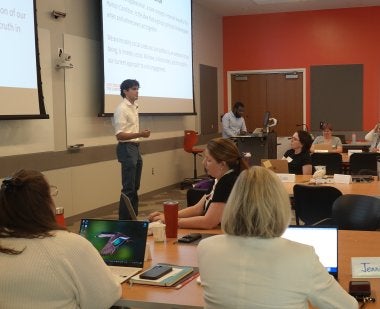
With the midterm election approaching, a group of University of Maryland instructors recently met with two representatives from the nonpartisan initiative TerpsVote in the Division of Student Affairs to learn about how they can support and encourage their students to vote this fall and throughout their lives. The session was part of a summer seminar for the professional development program Civic Engagement Across the Curriculum at the University of Maryland (CEAC at UMD), which took place from July 14 to 16.
The 13 instructors, representing nine colleges, schools and campus units, were part of the third cohort of CEAC at UMD. The program provides training and ongoing support and consultation to help instructors incorporate civic learning and community-focused strategies and experiences into their courses in nonpartisan ways in a variety of subject areas, ranging from women in literature, to fire protection engineering, to social media content creation. Since CEAC at UMD launched in 2024, 38 UMD instructors have updated more than 40 courses and syllabi across twelve colleges, bringing civic learning to an estimated 3,000 students.
“Faculty and instructors from a wide variety of disciplines have been seeking ways to improve their teaching about civics in ways that align with effective, research-driven instructional practices and that help their students make connections between their coursework and how they can help address real-world problems now and into the future,” said Lena Morreale Scott, director of the Civic Education and Engagement Initiative in the College of Education and principal investigator of the Maryland Democracy Initiative. “The Civic Engagement Across the Curriculum Program helps instructors reimagine teaching and learning while supporting them in tackling challenging issues such as how to teach about voting and elections in ways that are nonpartisan and connected to their existing curriculum. We’re proud to feature the good work that TerpsVote is doing to engage students, faculty and staff in the peak seasons of elections, but also between elections and year-round.”
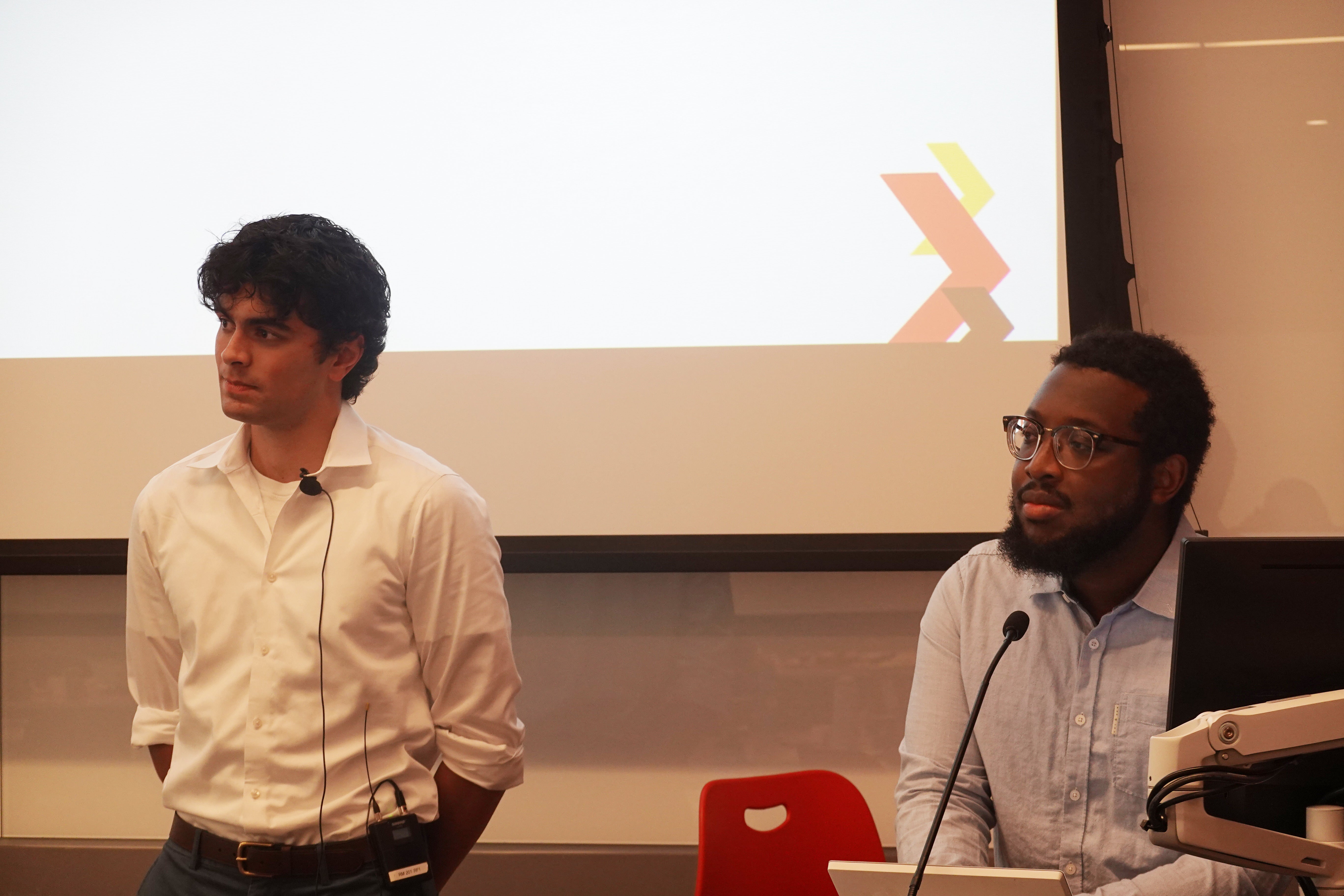
Anderson Harlor ’29 and Keith Ferguson of TerpsVote led the session on voting.
“We want to make voting just a part of our lives as a community. It shouldn't be this big, scary thing that you do every four years. It should be something natural,” said Ferguson, program manager of TerpsVote and coordinator for social action and civic engagement in the Office of Leadership and Community Service-Learning in the Division of Student Affairs.
“Educators have a very unique responsibility because we're so malleable at this age,” added Harlor, a TerpsVote intern who is pursuing a double major in philosophy, politics and economics, and government and politics. “What you tell us now really sticks with us for the rest of our lives, and voting is a habit-forming practice.”
Here are a few key takeaways and ideas that Harlor and Ferguson shared:
1. Connect voting to issues that matter to students. Harlor told participants that Gen Z is driven to vote primarily by issues that are relevant to them, more so than by allegiance to a political party or a sense of moral obligation. In a recent national survey of 5,549 18- to 29-year-olds, administered by the Center for Information and Research on Civic Learning and Engagement (CIRCLE) at Tufts University and the nonpartisan initiative When We All Vote, respondents identified cost of living and inflation as their top issue, followed by healthcare and housing costs.
“You can really boil it down to: economic concerns motivate students,” said Harlor. He suggested that educators can facilitate dialogues or mock debates about ballot measures that directly affect students to show that “politics touches every part of your life.”
“Communities don’t progress, evolve or move forward without the folks in [educational] spaces being interactive and engaged,” added Ferguson “Classrooms are made for sharing experiences and knowledge.”
2. Help students navigate the voting process. In 2023, nearly all respondents (94%) to a UMD Campus Assessment Working Group survey of 1,119 juniors and seniors agreed that it is important for college students to vote, yet only 44% of UMD students voted in the 2022 midterm elections. Many young people care about voting but do not understand the process. Instructors can help by including Election Day, early voting dates, and absentee ballot deadlines on their syllabi and Canvas pages, along with the link to TurboVote, which allows users to register to vote, update or check their voter registration, find their polling places and sample ballots, and get election reminders. They can make it easier for students to vote by not scheduling classes on Election Day or by holding virtual asynchronous classes. In addition, they can take time in class to discuss some of the practical issues around voting, like where to get stamps and envelopes for students who wish to vote by mail.
3. Make voting social. Humans are innately social, and college students tend to trust their peers and seek out social relationships and community, Harlor explained. He suggested that instructors can emphasize how voting connects to relationships, identity and belonging as people work together to address community issues. Instructors can create opportunities for students to interact with their peers and make voting a social event. Harlor shared that recently, a group of students gathered in a friend’s dorm room to fill out their mail-in ballots together to make sure they all returned them on time. “If you can make mail-in voting a social affair, it's no longer a daunting task,” he said.
For example, Ron Mower, a senior lecturer in kinesiology and a member of the current CEAC at UMD cohort, said that he plans to leverage the social connections he already works to build in his Social Justice in Kinesiology class to encourage voting. “I try to cultivate a classroom environment where all of the students really know each other. So we do a lot of activities that encourage that, and moving around so they're not working with the same people week to week,” he said. During the fall semester, he plans to use these practices to encourage “mobilization towards voting and being more politically active.”
4. Encourage all students to be civically engaged, including those who are not eligible to vote in U.S. elections. All residents ages 16 and older, including non-U.S. citizens, are eligible to vote in local elections in College Park, Harlor shared. In addition, all students, regardless of age or citizenship status, can participate in student government or other civically engaged student or community organizations, attend local city council meetings, and stay current on local, national and global news.
In addition to the session on voting, participants in the CEAC at UMD summer seminar learned about ways to integrate civic engagement learning practices—such as service learning, intergroup dialogue and community partnerships—into their specific disciplines. They also explored how to evaluate online social and political information and met with members of past CEAC at UMD cohorts to discuss their experiences with incorporating civic engagement into their courses.
During a separate in-person seminar held July 28 and 29, CEAC PreK-12 convened its first cohort of middle school teachers. The cohort of 15 middle school educators in the new pilot program hailed from 10 schools in eight districts across Maryland, including Baltimore City and Anne Arundel, Baltimore, Dorchester, Montgomery, Somerset, Talbot and Wicomico Counties. They teach a range of subjects, including English Language Arts, English Language Development, math, reading, science, social studies and Spanish. The participants learned about evaluating online resources, facilitating discussions and helping students take action on issues that matter to them.
CEAC at UMD is delivered by cross-campus partners in Faculty Affairs and Student Affairs including the Maryland Democracy Initiative, Center for Community Engagement, Teaching and Learning Transformation Center, Office of Leadership and Community Service-Learning, and Department of Resident Life, in partnership with the Institute for Public Affairs and Civic Engagement (PACE) at Salisbury University. This year’s program is made possible by a gift from Henry Laufer and Marsha Zlatin Laufer '64 to the Maryland Democracy Initiative. The pilot program was supported by grants from the University System of Maryland and Transform MidAtlantic.
In addition to Scott, the leadership team and summer seminar faculty for CEAC include Genevieve Conway, assistant director for living-learning and academic support initiatives in the Division of Student Affairs; Ginny Hutcheson, learning experience designer in the Teaching and Learning Transformation Center; Nicole Mehta, assistant director for deliberative dialogue and community-centered engagement in the Department of Resident Life; Julie Miller, postdoctoral associate in the Civic Education and Engagement Initiative in the College of Education and the Maryland Democracy Initiative; Tania D. Mitchell, associate provost for community engagement in the Center for Community Engagement and professor in the Department of Counseling, Higher Education and Special Education in the College of Education; Sarah Montana, graduate assistant in the College of Education and team member in the Maryland Democracy Initiative; Elizabeth Reynolds, postdoctoral associate in the College of Education and team member in the Maryland Democracy Initiative; Kamrie Risku, coordinator for curriculum and partnerships in the Office of Leadership and Community Service-Learning in the Division of Student Affairs; and Wendy Wagner, director of faculty engagement in the Center for Community Engagement.