It’s 5 a.m. on a Thursday, and Haley Melby ’26, M.Ed. ’27, a first-string outside hitter for Maryland’s volleyball team, already is up and mentally preparing herself for the day’s big matchup: a first-grade class at the nearby public school, Beltsville Academy.
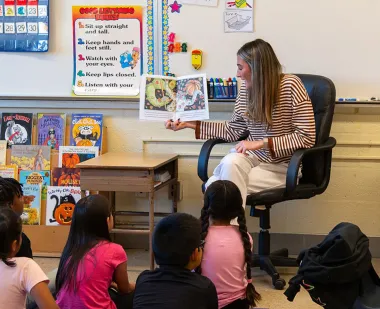
At midmorning, she’s captured the attention of all 13 6-year-olds sitting on a colorful classroom carpet with a story called “There Was an Old Lady Who Swallowed Some Leaves.” After the giggly storytime, complete with sound effects, Melby sits with a small group at a circular table, helping the students sound out vocabulary words.
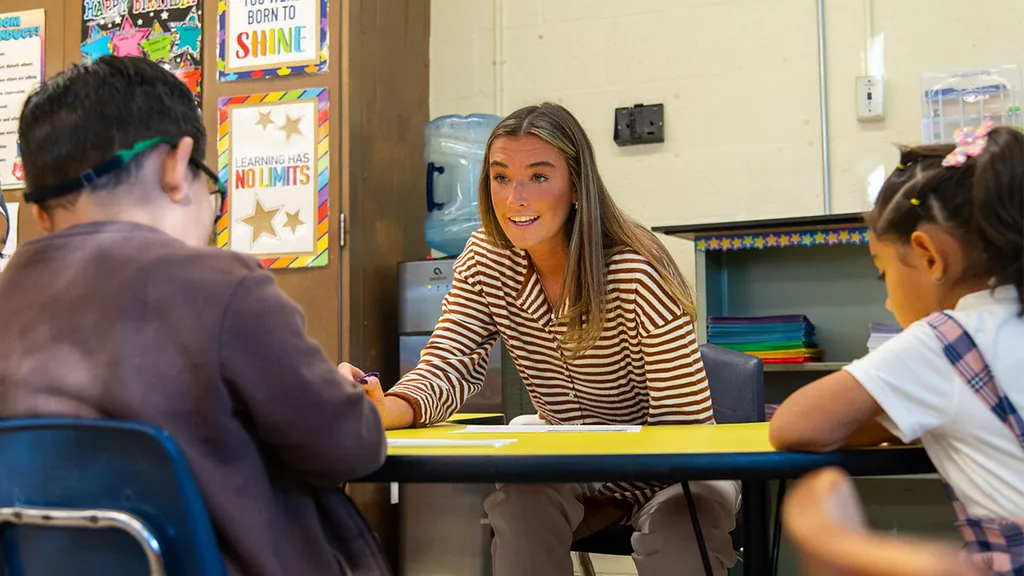
After a full day of student teaching, Melby races back to campus to join her team practice. It’s a long day by any measure, but it allows her to prove that Division I athletics and student teaching can coexist.
Melby is helping pilot the new Terrapin Teaching and Coaching Pathway, a program designed to help student-athletes become certified teachers while competing.
For Melby, it helps that Beltsville Academy has an early start time, allowing the Indiana native to still make afternoon practices with her team.
“I'm not even tired by the time I get home, because I'm just so happy to be around the kids,” said Melby, who will lead the Terps into the inaugural Big Ten Volleyball Tournament on Friday. “Without this program and the support of everyone, I would have not been able to do my student teaching this semester, and it would have taken me five years to complete my undergrad.”
Instead, Melby is on track to complete her Master of Education degree with teacher certification (MCERT) in elementary education next year — all while juggling the demands of a competitive Big Ten sport.
Athletes don’t often choose education as a major, not because they aren’t interested in teaching, but because of the demands of NCAA eligibility requirements and their teams’ practice schedules, said Brady Rourke, director of the Gossett Student Athlete Center for Academic and Personal Excellence, who created the program in 2024 with Loren Jones, associate chair and associate clinical professor in the College of Education.
“There are a lot of transferable skills between athletics and being able to successfully teach and lead and coach,” Rourke said. “So we want to make it possible for students to have the option.”
Two other athletes, both track and field runners, have completed the Terrapin Teaching and Coaching Pathway, but Melby is the first student to student-teach during their season.
“We strive to make this career path available to any athletes who may be interested,” said Jones. “The internship structure varies by content area, so we work with athletes on a case-by-case basis to determine what is possible.”
“We believe that students should not have to choose between their academic and professional goals and their athletic commitments,” added Karen Rehder, coordinator of the elementary education program and the elementary MCERT professional development school coordinator. “By providing flexibility and creating an accessible pathway that accommodates her athletic schedule, we have been able to support Haley in fully engaging in the internship experience while continuing to thrive as a student-athlete.”
Melby sometimes misses a few reps in weight-training with her team because of her schedule as a student teacher, but she makes up the strength training time with a trainer after court practice. And when the team travels for tournaments, she may miss a day with her first-graders in Ms. Karin Ruyle’s class.
Growing up with parents who were high school teachers, Melby knew from an early age that she also wanted to work with children. Like many athletes, she initially majored in business, but she realized quickly that she wanted to explore education.
“I know how important the job is and how big of a need there is for teachers in our country right now,” said Melby. “I think a lot of athletes would make great teachers.”
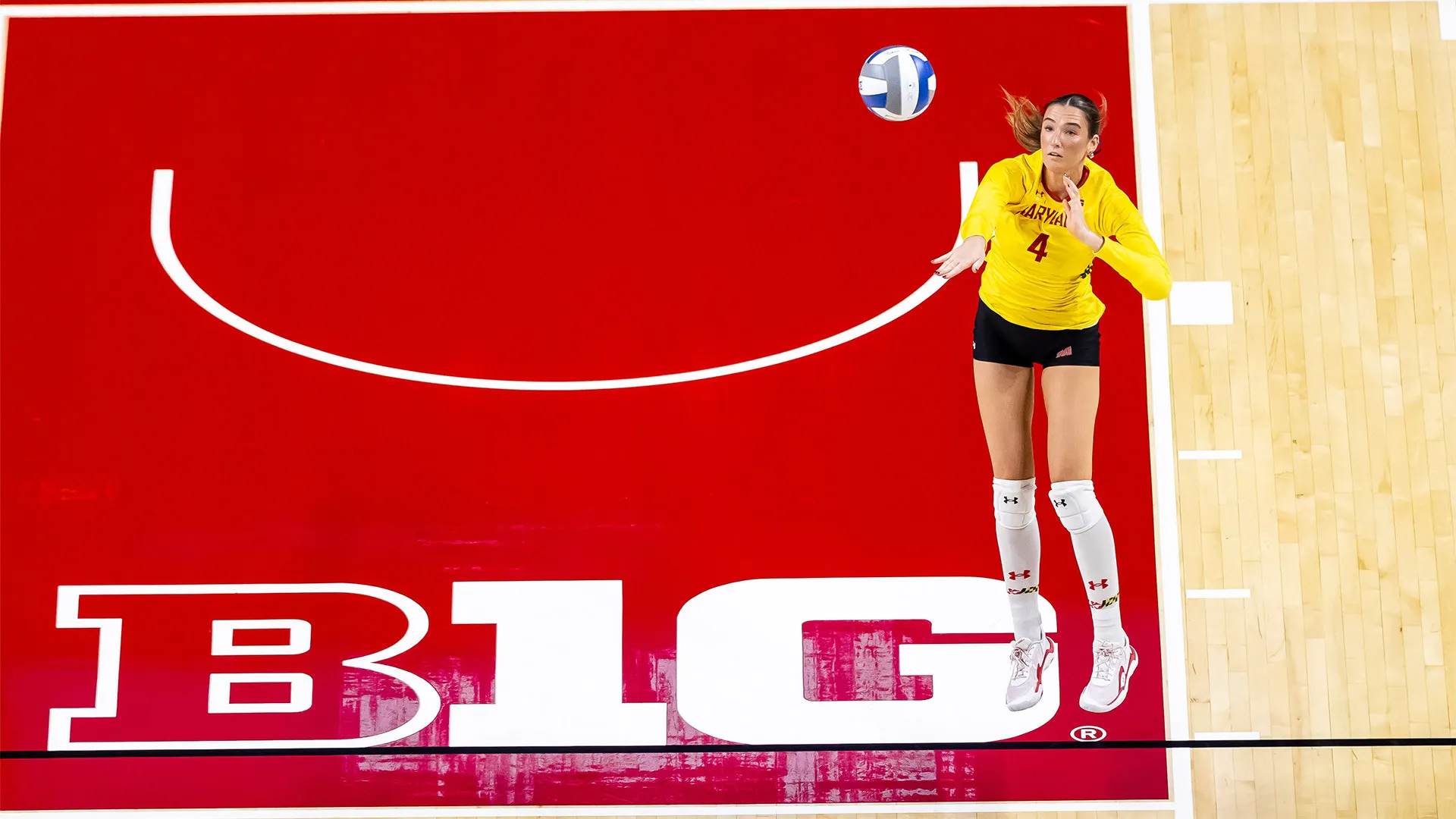
Ruyle, Melby’s mentor teacher, said she had an opportunity to attend one of her volleyball games. “What I saw from Miss Melby was exceptional teamwork, great leadership, lots of communication and tremendous perseverance. It is these life skills that she also brings into the classroom and will help her in being a superior teacher,” said Ruyle.
Melby’s first-graders have heard she plays volleyball, but they haven’t yet seen the 6-foot-2 student teacher spike a ball. (There’s no net on the playground.)
“I can’t even imagine having a Division I volleyball player walk into your elementary class,” said Rourke. “The role-model part of this is just so cool. Think about how life-changing it is for those kids to have a college athlete as their student-teacher.”
This article is adapted from a story that first appeared in Maryland Today.
Photos by Amina Lampkin