

Teaching and Learning, Policy and Leadership - Literacy Education Specialization, Ph.D.
Doctor of Philosophy
Program Overview
The Ph.D. in Teaching and Learning Policy and Leadership with a Literacy Education specialization will prepare you to become a scholar and leader in the field of literacy education. Our program emphasizes the connection among theoretical frameworks, empirical research, and practical application in literacy education. This integrated approach will enable you to develop the scholarly expertise needed to rigorously investigate and address real-world challenges in diverse school and community contexts. You will also develop the practical skills needed to collaborate with a community of scholars and practitioners to advance equitable literacy opportunities and access for all.
Our program faculty brings diverse research interests and expertise in literacy education with young children, youth, and adults. Our scholarship reflects a range of perspectives, approaches and contexts, providing opportunities for you to engage with research that aligns with your interests and prepares you to address complex literacy challenges in four key domains:
- Critically theorize literacy as socially situated, multimodal, and cultural. You will develop sophisticated understandings of literacy as more than acquisition of print based skills, examining how meaning is constructed across linguistic, visual, digital, embodied and other modes. You will also critically engage theories of multimodality, language, culture and identity and apply these perspectives to literacy research, literacy teaching and learning, and literacy teacher education and professional development.
- Interrogate children’s and adolescent literature as a site for inquiry, identity, and social transformation. You will critically analyze children’s and adolescent literature as complex texts that shape how young people understand themselves, others, and the world. You will examine representation, voice, power, and access within literature and explore how literary texts can support critical literacy, multimodal meaning-making, identity development, and equitable learning opportunities.
- Examine emerging technologies as sites of literacy, opportunity, identity, and equity. You will investigate how AI, digital and multimodal technologies, and other emerging literacy practices shape the literacy development, identities, agency, and educational opportunities for all learners, but especially for learners from diverse backgrounds.
- Examine culturally responsive approaches to literacy teaching and professional learning. You will develop the knowledge and expertise to support teachers in creating literacy learning environments that recognize and build upon students’ cultural, linguistic and community assets. You will examine how professional development and teacher education can foster responsive, reflective, and transformative learning practices.
#14
Best Education Policy Program, According to U.S. News & World Report
#16
Best Curriculum and Instruction program by U.S. News & World Report
Program Benchmarks
Program Benchmarks
The Comprehensive Exam. Students complete a comprehensive exam, usually in the third year of their program. Students consult with their advisor to formally initiate the comprehensive examination process. The comprehensive exam takes the form of a portfolio that includes a literature review, an academic paper/manuscript, and materials from a presentation (e.g., presentation slides) given at a professional conference. Portfolio components should be thematically connected and reflect the student’s area of interest in literacy education. The portfolio is evaluated according to a rubric by at least two program faculty. After students earn a passing score on the portfolio, they formally complete their comprehensive examination process and advance to candidacy.
The Dissertation Proposal. After advancing to candidacy, students work with their advisor to develop a written Dissertation proposal for their dissertation study. The written proposal presents a rationale for the study, prior relevant research, research questions, research methodology and methods, and a timeline for the work. A dissertation committee meets with the student for a formal Proposal Defense before beginning the dissertation research.
The Dissertation. Students produce a final dissertation based on the Dissertation Proposal. The results of their dissertation study are written up and presented at a Dissertation Final Defense with the student’s dissertation committee.
Career Options
Our graduates pursue a number of careers in literacy education including:
- Academic Researcher (within foundations, think tanks or specialized research centers)
- College and University Faculty
- Curriculum Developer
- Curriculum Specialist
- Educational Consultant
- Literacy Interventionist
- Teacher Educator
How to Apply
How to Apply
Information on admissions and application to this program can be found on the University Graduate Admissions website and the program handbook.Students must apply directly to the Graduate School for admissions.
Preparing Your Application: What We're Looking For
While all application materials are carefully reviewed, the Statement of Purpose (SOP) is a critical component of your application. Your SOP should describe your academic and professional journey, explain how your interests in literacy education have developed and articulate the research questions or topics you hope to pursue.
We encourage applicants to discuss relevant professional experiences, lived experiences, and intellectual influences that have shaped their interests. You should also explain how your research interests align with the Literacy Education program and identify one or more faculty members whose work connects to your goals. Additionally, describe how earning a Ph.D. will support your long-term academic and professional aspirations.
Relevant experiences, such as teaching literacy in schools, literacy tutoring, or engaging in literacy-related research, may help provide context for your interests and preparation.
The recommended length for the Statement of Purpose is 1,500–2,000 words.
Applicants must also submit a Statement of Personal Experiences (100–300 words). This statement provides an opportunity to reflect on how your lived experiences, including those beyond academic or professional settings, have shaped your personal growth and prepared you for doctoral study.
For guidance on preparing your statement, please review the Statement of Purpose and Personal Experience prompts provided by the University of Maryland.
Applicants must submit three letters of recommendation. We recommend that most letters come from faculty members who can speak to your academic abilities, research potential and readiness for doctoral study. You may also include a letter from a professional supervisor or colleague, such as a school principal or educational leader, who can provide insight into your professional experience and qualifications.
"The Ph.D. program in literacy education gave me theoretical tools to excavate and name what I witnessed in teaching and learning, knowledge that will endure through my writing and students."
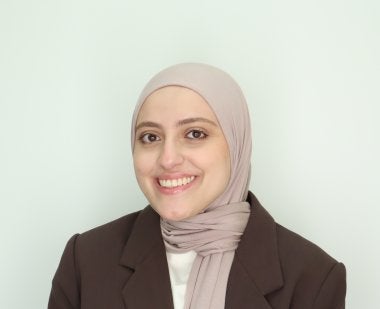
Rasha Alkhateeb, Ph.D. '26
Requirements
Program Requirements
Our program takes an average of five years to complete. During that time, students are expected to maintain a full-time course load and fully immerse themselves in the literacy education specialization community and the broader department.
Most students admitted to the doctoral program have a master’s degree. If you have a master’s degree, you will take a minimum of 60 credits to complete the doctoral degree. If you do not have a master’s degree, you will take a minimum of 70 credits. Students are assigned an academic advisor to help them develop a program of study..
After completing 48 credits of coursework (58 for students with no prior master’s degree), students complete a Comprehensive Exam to advance to candidacy. The Comprehensive Exam is a portfolio that consists of research products from the student’s first 3 years of the program. After successfully passing the Comprehensive Examination, students advance to candidacy and write and defend their dissertation proposal. Students convene a dissertation committee which approves their written dissertation proposal in a formal defense. While working on the dissertation, students are enrolled in an additional 12 credits of Dissertation Research. Students defend their written dissertation thesis in a formal Final Defense that is open to the public.
The doctoral program coursework is listed below.
All full-time students in a Ph.D. program in the Department of Teaching and Learning, Policy and Leadership complete a 2-course sequence or core, integrated foundational courses.
- TLPL 794: Foundations of Educational Inquiry I (Core 1)
- TLPL 795: Foundations of Educational Inquiry II (Core 2)
The 30-credit requirement is comprised of Specialization Core courses (9 credits) and electives (21 credits), providing a strong foundation in literacy education while allowing students to tailor their program of study to their scholarly interests and professional goals. Students are strongly encouraged to regularly consult with their advisors to ensure that they fulfil the specialization credit requirement.
Students are required to take four research methods courses, including one qualitative methods course and one quantitative methods course. Students may take research methods courses offered by the College of Education or other academic programs across campus. We strongly encourage students to consult with their advisor before enrolling in research methods courses outside of the department.
Though not an exhaustive list, some example courses are below:
Qualitative Courses (at least one course)
- TLPL 790: Seminar in Mixed Methods Research in Education
- TLPL 791: Qualitative Research I: Design and Fieldwork
- TLPL 792: Qualitative Research II: Analysis and Interpretation of Data
- TLPL 860: Seminar on Case Study Methods
- TLPL 762: Phenomenological Inquiry I
- TLPL 763: Phenomenological Inquiry II
Quantitative Courses (at least one course)
- TLPL 692: Statistical Literacy for Education Research
- TLPL 790: Seminar in Mixed Methods Research in Education
- EDMS 646: Quantitative Analysis II
- EDMS 651: Applied Regression Analysis
- EDMS 657: Factor Analysis
- EDMS 722: Structural Modeling
- SURV 699K: Multilevel Analysis of Survey Data
Students enroll in at least 12 dissertation credits after their coursework is completed. Students must be enrolled in dissertation credits during the semester that they defend their dissertations. Students are encouraged to consult with their advisor to request more information.
Faculty
Faculty
Our faculty are chosen for their expertise and dedication; they provide exceptional guidance and support to foster your academic and professional success.
- Kerry Alexander, Assistant Professor
- Ayanna Baccus, Associate Clinical Professor
- Reka Barton, Assistant Professor
- Shannon Kane, Assistant Clinical Professor
- Wayne Slater, Associate Professor
- Jennifer Turner, Professor
- Peggy Wilson, Associate Clinical Professor
Contact
Contact
For general information, please contact:
Kay Moon
Graduate Coordinator (Admissions)
kmoon@umd.edu
For more information regarding the literacy education doctoral program please contact:
Jennifer Turner
jdturner@umd.edu