
Dyslexia isn’t just frustrating for children struggling to decipher squiggles as letters. At schools that can’t support students one-on-one, it can be costly for parents who turn to private reading tutors.
A new virtual reality game led by Terps offers an alternative, helping kids to learn letters, build words, and connect sight and sound as they race through obstacles in a fantasy world—while still in their classrooms.
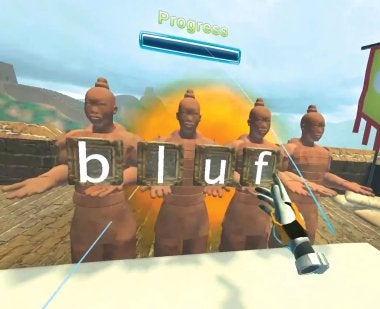
IRIS Reads, co-developed by University of Maryland education Associate Professor Donald J. Bolger, linguistics Professor Juan Uriagereka and physics Professor Drew Baden and helmed by CEO Anne-Laurence Nemorin ’20, has students ages 8-13 travel to Antarctica, the Great Wall of China and the pyramids of Giza to chase time bandits who have stolen historic objects. Through each level, students might “grab” different letters out of the air to create words or “slice and dice” words into different syllables (à la Fruit Ninja) to gain confidence in reading.
Dyslexia is surprisingly prevalent, affecting about 20% of the population. That includes Uriagereka’s son, now a student at UMD.
“As a parent, when you see a perfectly smart kid that is having these difficulties, you want to do whatever you can to help them,” he said, recalling years of one-on-one tutoring sessions. “If you leave them on their own, they can be very frustrated. … That’s why we wanted to create this ‘Percy Jackson’-like adventure game.”
Using a VR headset removes distractions, especially welcome for dyslexic kids who also struggle with attention and auditory or visual processing, said Bolger, who investigates the neurocognitive underpinnings of language development and reading. “Your whole body is engaged,” he said. “These are fundamental skills, but it’s also really fun.”
IRIS Reads has been tested in schools that specialize in dyslexia around the D.C. metro area. Students have demonstrated a 13-22% increase in standard reading scores after playing regularly in class.
“Learning to read can get boring. It takes a lot of repetition and drills every day, so any time you can get something visually different it’s good,” said Karen Gallo, literacy coordinator at the Chelsea School in Hyattsville, Md. She’s used the game since 2024, and said her middle schoolers love the “big movements” and that “spray painting” in the air really helps them with writing numbers and letters.
More students will soon get the chance to play. The IRIS Reads team, which has been supported by university and state funding like the Maryland Momentum Fund and TEDCO, plans to launch this summer for home and classroom use.
“It’s great because it’s at their own pace, they’re getting feedback and they really enjoy it,” said Gallo. “You can see them start to build confidence, and that’s a huge thing.”