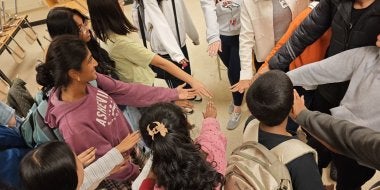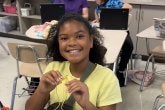
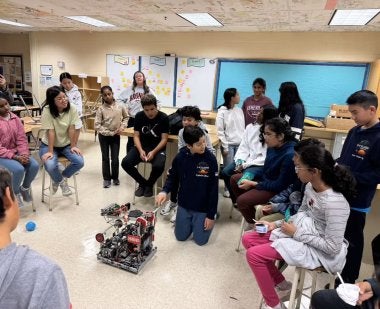
In October, the University of Maryland and Montgomery County Public Schools (MCPS) launched a new yearlong afterschool robotics program in five middle schools, in partnership with community organizations.
Chunyan Yang, associate professor in the Department of Counseling, Higher Education and Special Education, leads the team that developed and is piloting Co-Learn Code and Mind. The program provides students, especially those in low-resourced communities or schools, with hands-on opportunities to codesign, build and program robots while seeing themselves as ethical innovators in artificial intelligence (AI) and robotics.
In addition to robotics and AI literacy learning, the program integrates two other core components: youth participatory inquiry, where youth lead investigations of issues in their own communities, and transformative social emotional learning, which helps students develop a sense of belonging, identity, curiosity, agency and collaborative problem-solving skills.
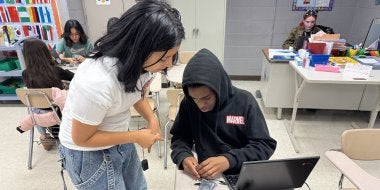
While the program intentionally builds students’ coding and robotics skills, it also goes beyond technical instruction to encourage students to reflect on their lived experiences and observations of the assets, strengths and challenges in their schools and communities that matter most to them. Each week during the fall and winter sessions, as students collaborate on robotics design, coding, programming and building, they engage in group discussions and reflective activities. They explore topics such as how they made their voices heard in their teams while listening to others’ ideas, how their robotics projects could make everyone in their communities feel supported and included, and how youth can be leaders in robotics design. They also engage in learning and practicing different types of participatory inquiry approaches as youth researchers, such as photovoice (taking photos to capture their daily experiences), focus groups to draw connections across shared experiences and brainstorm ideas, and observations of how spaces are used and how people behave or interact in schools and communities.
“Instead of centering the machine, we center young people, their communities and the purpose behind their work,” said Yang. “The robot is only the doorway; the real learning happens in the reflection, the collaboration and the sense of possibility that students begin to feel. The ultimate goal is to plant the seeds for students to see robotics and AI as tools for human- and community-centered participatory design, empowering them to cocreate solutions that reflect their values and lived experiences.”
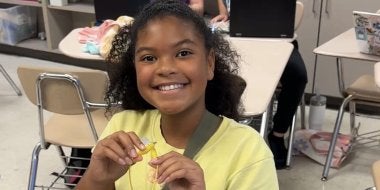
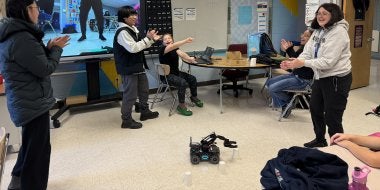
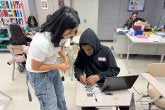
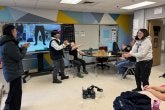
During the first few weeks of the program, representatives from UMD’s Small Artifacts (SMART) Lab and the community-based Academy of Excellence (AOE) Robotics Club visited each school to give robotics demonstrations. Students have since built and programmed cardboard robots while learning about AI literacy and human-centered design. Over the remainder of the school year, students will also create AI-enabled cardboard robots and modularized robots (e.g., Vex IQ Robotics) while engaging in integrated social and emotional learning activities.
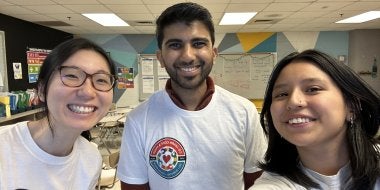
To foster an intergenerational learning environment, facilitators and mentors of a variety of ages work with the students, including students from MCPS high school STEM clubs, UMD undergraduate robotics minors, UMD graduate students in school psychology and computer science, MCPS teacher sponsors and senior adult volunteers from the Jewish Council for the Aging. The Special Education Equal Development Society is also a partner on the project and will help support the meaningful involvement of neurodiverse students.
Shauna-Kay Jorandby, director of student well-being in the MCPS Division of Specialized Support Services, and Shella B. Cherry, director of student leadership and extracurricular activities in the MCPS Division of School Leadership and Improvement, are deeply involved in the program’s development and implementation. In addition, Julie Yang, former president of the Montgomery County Board of Education, and Thomas Taylor, MCPS superintendent, played a key role in establishing and supporting the project.
UMD faculty collaborators include Huaishu Peng, assistant professor in the Department of Computer Science; Fengfeng Ke, Clark Leadership Chair and professor in the Department of Teaching and Learning, Policy and Leadership; Wei Ai, assistant professor in the College of Information; and Ryan Daniel Sochol, interim director, and Eric Tomala, assistant director, both of the Maryland Robotics Center.
The Co-Learn Code and Mind program is supported by a seed grant from the Artificial Intelligence Interdisciplinary Institute at Maryland (AIM) and through MCPS’s investment in teacher leadership via stipend support for school-based program sponsors.