The Maryland Democracy Initiative and the University of Maryland College of Education co-sponsored the event “Who Has the Power? The Constitution and Our Role in Securing Democracy” on April 27 in the Stamp Student Union. The event was part of a yearlong exploration of the U.S. Constitution, which UMD selected as its 2025-26 First Year Book, as the nation prepares to celebrate its 250th anniversary.
The event began with presentations from three speakers, each of whom addressed one of the first three articles of the Constitution, which establish the roles of the three separate branches of the federal government and their powers. The speakers connected the Constitution’s text to current news and controversies and shared insights about how constitutional principles have shaped our democracy and political landscape historically and today.
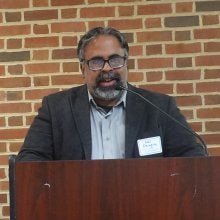
Molly Reynolds, vice president and director of Governance Studies at the Brookings Institution, discussed Article I (the legislative branch/Congress). Chris Piper, a policy researcher at the Partnership for Public Service, examined Article II (the executive branch/President). Finally, Neil Dhingra Ph.D. ’25, a graduate academic advisor in the UMD College of Information who holds a doctorate in education policy from UMD, discussed Article III (the judicial branch/Supreme Court and lower federal courts).
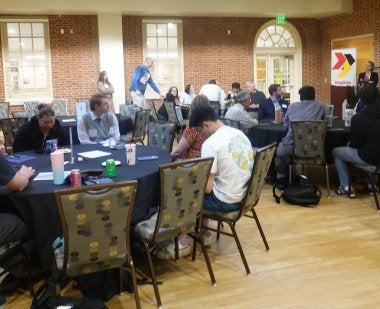
After hearing from the experts, participants—including education faculty and aspiring social studies teachers—divided into small groups to discuss how they currently engage in conversations about constitutional principles with their students, colleagues, friends or family members. For example, a group of educators discussed ways constitutional rights and the balance of powers have come up in the classroom, and the challenges of keeping up with the ever-changing news cycle and navigating constitutional issues with students during polarized times.
“The event was designed to help all of us who work with students think about the Constitution in an era when there are so many constitutional questions,” said Elizabeth Reynolds, a Ph.D. candidate specializing in teacher education and professional development, who was the main organizer of the event. “Pro-democracy movements in the U.S. have historically leveraged the Constitution to make this country more democratic. Our current pursuit of a true pluralist democracy can take advantage of the same strategies, and that starts with knowing what the Constitution does and does not say.”
Here are a few takeaways from the event:
Policies may be controversial but still constitutional.
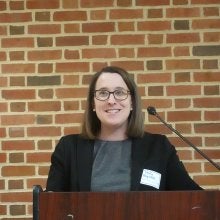
People may disagree strongly with a law Congress passes, but that does not necessarily mean that law is unconstitutional, Molly Reynolds said. Examining the text of the Constitution can help us tell the difference. For example, she explained, although the One Big Beautiful Bill Act was polarizing, it was clearly within Congress’s power to pass the law because Article I gives Congress the power to collect taxes and determine federal spending. “It’s contentious politically but not constitutionally,” she said. She contrasted that with President Donald Trump’s tariffs, which the Supreme Court ruled against because the Constitution does not give the president the power to impose tariffs or taxes.
The Constitution is the imperfect result of compromises made during a challenging period of U.S. history.
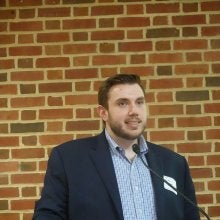
Article II is fairly vague about the powers of the president, Piper said. “The vagueness wasn't a flaw,” he said. “It was the price of getting consensus and getting the Constitution ratified.” Over time, presidents have used some of those vague clauses to expand their power—such as the Vesting Clause, which states that “executive power shall be vested in a President of the United States” but isn’t clear about what “executive power” means, said Piper. The founders designed a system of checks and balances to stand the test of time and reign in executive power, he explained, but they did not foresee modern partisanship. For example, they assumed members of Congress would act to defend their own powers, rather than in defense of a president from their same political party, he said.
Determining whether power is legitimate requires independent judgment.
Article III establishes an independent judiciary that, as Alexander Hamilton wrote in Federalist 78, is necessary to protect minority and individual rights from potential oppression by the majority, Dhingra said. The judiciary determines whether or not the other branches are exercising their power in legitimate ways, said Dhingra, who described Supreme Court cases related to education as examples. He discussed the 1982 ruling in Plyler v. Doe that protected funding for undocumented children to attend school, finding that education is more than just a government benefit because it enables people to engage with democracy and gain economic and psychological well-being. He also described several cases that sought to prevent public education from becoming a homogenizing force that could interfere with families’ efforts to preserve their own languages, cultures, values or religious beliefs.
“These educational questions are meaningful and shouldn’t just be answered as questions of power,” said Dhingra. “These questions require judgment.”
To uphold the Constitution, institutions need to take action.
Last summer, the Department of Education withheld almost $7 billion that Congress had appropriated to K-12 schools, Molly Reynolds said, but the administration released the money fairly quickly after immediate bipartisan pushback from Congress, as well as lawsuits. “The executive branch tried to encroach on Congress’s power. We saw a response that changed the executive branch’s behavior, but it had to come from multiple other branches,” she said. “Our constitutional principles are not self-enforcing. You need political institutions to exert their own power in order to keep the system of checks and balances.”