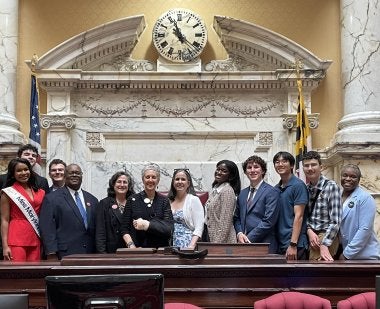
Over the past year, faculty, staff and students from the University of Maryland College of Education have engaged in advocacy and legislative work at both state and federal levels. EdTerps have testified, met with legislators and helped to craft policy addressing a variety of issues including civic education, school evaluation processes, special education and disability rights, literacy, teacher preparation and federal student aid.
During the 447th legislative session of the Maryland General Assembly, which adjourned on April 13, three bills that EdTerps advocated for passed, and two of the initiatives they supported were funded in the state’s fiscal year 2027 budget. Maryland Governor Wes Moore signed two of the bills into law on May 26 and will allow the third to become law without his signature.
Maryland Seal of Civic Excellence
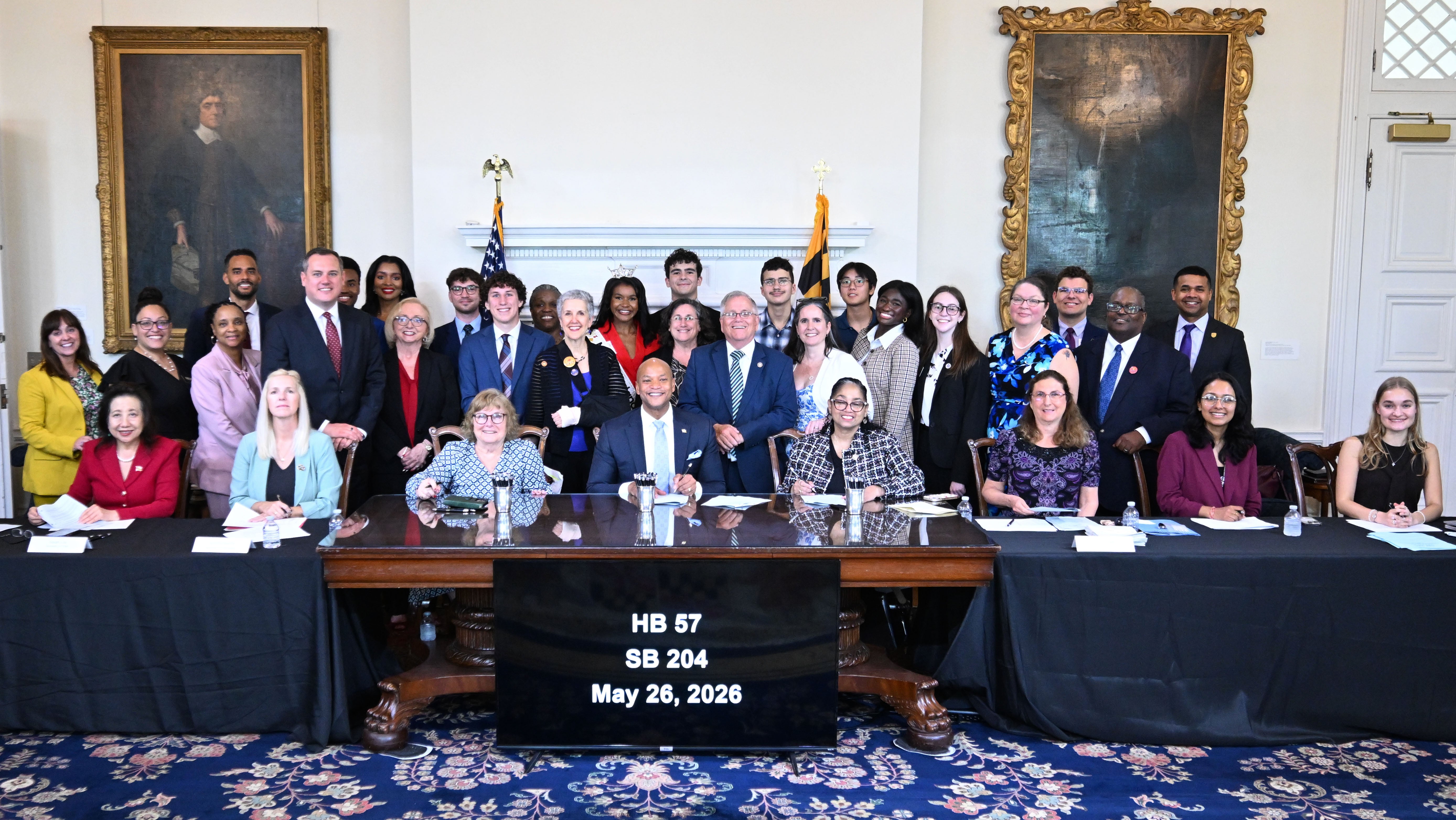
Governor Moore signed HB0057/SB0204, commonly known as the “civic seals” bill, on May 26. It will establish the Maryland Civic Excellence Program to award a Seal of Civic Excellence to public high school students who exhibit civic readiness and engagement and who complete a capstone project. The program will be established no later than the 2027-28 school year. The first version of the bill was introduced in 2023.
Lena Morreale Scott, director of UMD’s Civic Education and Engagement Initiative, principal investigator of the Maryland Democracy Initiative and co-founder and chair of the Maryland Civic Education Coalition, testified in person (3:07:57) on January 29 before the Maryland House Ways and Means Committee in favor of the bill and submitted written testimony for the House and Senate hearings. In her testimony, she stated that high-quality civic education is “one of the most fundamental ways to strengthen our shared democracy.”
“An informed and engaged citizenry is essential to representative democracy, responsive government and to strong communities,” Scott told the Ways and Means Committee. “Negotiation, advocacy, consensus building, information and media literacy—these are skills that we can build with high-quality civics programs.”
Aspiring Educators Lobby Night
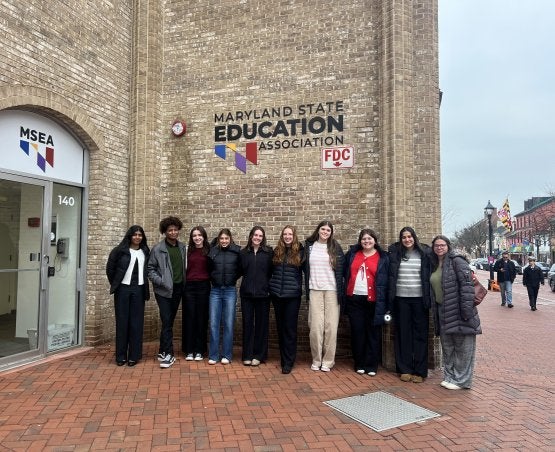
Ten College of Education students representing the Teacher Education Association for Maryland Students (TEAMS) met with four state legislators during Aspiring Educators Lobby Night with the Maryland State Education Association in Annapolis on February 16. The two bills they lobbied for were later passed by the Maryland General Assembly.
On May 26, Governor Moore signed the Comprehensive Outcomes and Measures of Progress for Supporting Schools (COMPASS) Act (HB1582). The law, which will take effect on July 1, will reform Maryland’s public school accountability and star rating system for a more holistic evaluation of a school’s performance.
The bill states that “national standardized testing may not be the only measure for evaluating educational accountability.” Instead, schools’ performance will be evaluated by at least three factors, one of which must be school climate surveys. Other metrics may include class size, case load, student growth, discipline and restorative practices, opportunities for advanced academic courses and/or career and technology education, and other factors.
The Data Privacy Act (HB0711/SB0504) will prevent state and local agencies and officers from sharing personal information such as school enrollment data, Motor Vehicle Administration records or public benefit applications for the purposes of federal immigration enforcement. Governor Moore did not sign the bill, but he will allow it to become law without his signature; it will take effect on July 1.
“The lobby experience was meaningful to us because it provided us an opportunity to work together and use our voices as aspiring educators to advocate for issues that we believe in and that will help better Maryland public education for students, teachers and families,” said Tili Dendukuri ’28, an elementary education major and TEAMS member who participated in Aspiring Educators Lobby Night.
TerpsEXCEED Annual Funding
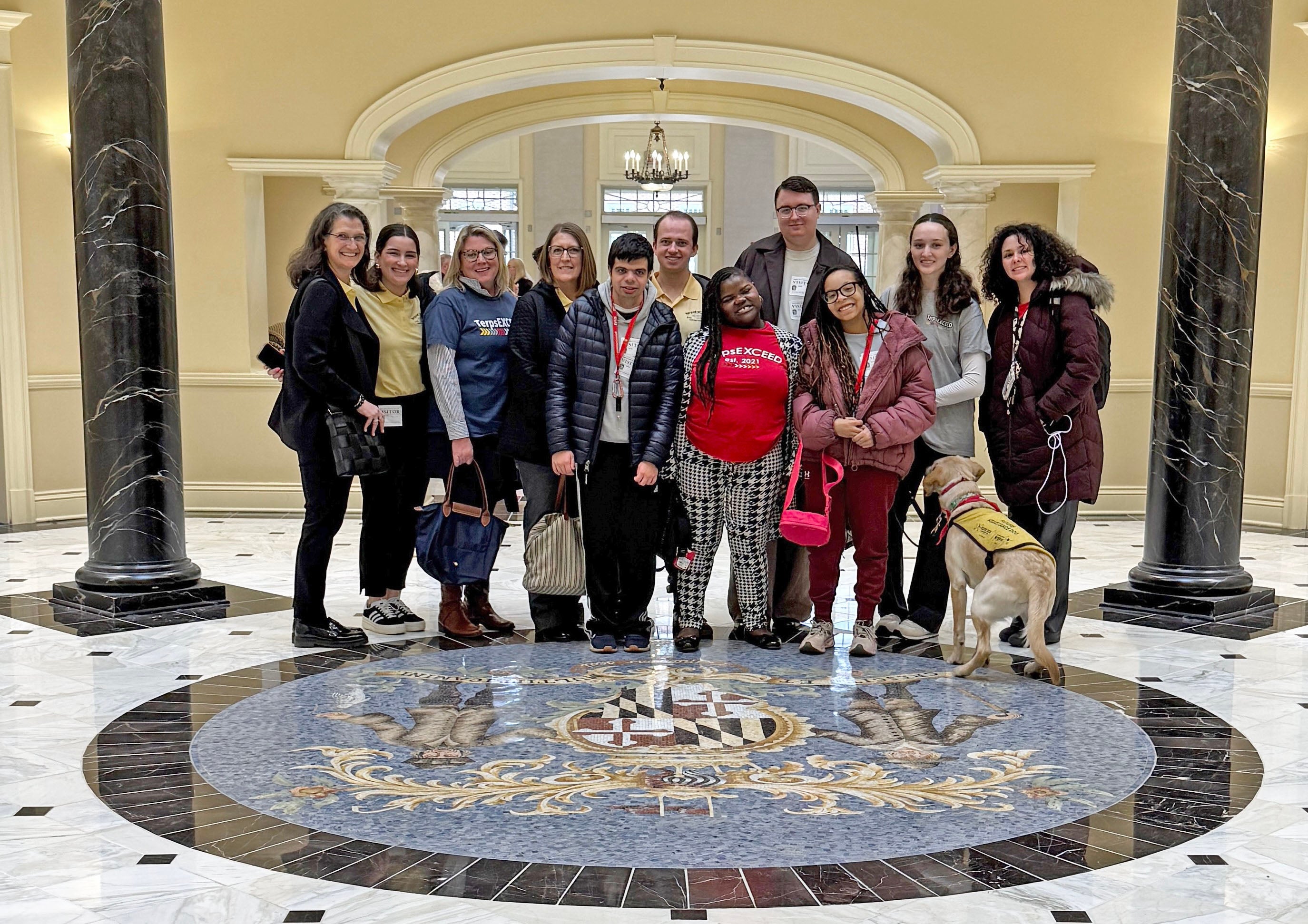
The Maryland General Assembly voted to include $200,000 in the state’s fiscal year 2027 budget to support TerpsEXCEED (EXperiencing College for Education and Employment Discovery) at UMD. TerpsEXCEED is an inclusive post-secondary education program that provides Maryland students with intellectual disabilities the opportunity to participate in a college experience for two years, culminating in a certificate.
HB0458/SB0603, which passed last year, allows (but does not require) the governor to authorize annual funding of up to $350,000 for TerpsEXCEED, starting in fiscal year 2027. Representatives from TerpsEXCEED must continue to advocate every year for the funding to be included in the budget. On February 18, as part of Developmental Disabilities Day at the Legislature hosted by the Maryland Developmental Disabilities Coalition, a group of 12 TerpsEXCEED students, graduates, peer mentors and faculty members traveled to Annapolis to meet with four state legislators to advocate for the funding. This year, Senator Craig Zucker introduced the funding for TerpsEXCEED into the supplemental budget, and Delegate Sarah Wolek helped push it through the House.
“We are so grateful to our state legislators—especially Senator Zucker and Delegate Wolek—for supporting TerpsEXCEED with funding,” said Amy Dwyre D’Agati, founder and director of TerpsEXCEED. “We are able to accept a larger freshman class, expand our staffing to continue our individualized services, grow our peer mentoring program and offer scholarships to students and families so that higher education is an option where it was not before. It also allows us to do outreach and support to other universities in Maryland who are interested in starting similar programs.”
MILE Advocacy
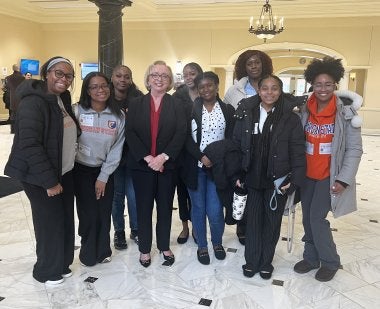
As part of the Maryland Initiative for Literacy and Equity (MILE)’s Advocates Day on February 26, more than 40 Morgan State University education students, accompanied by five UMD faculty members, staff members and doctoral students, traveled to Annapolis to meet with 18 state legislators. MILE, a partnership between the University of Maryland and Morgan State, organizes Advocates Day to amplify the voices of pre-service teachers.
MILE partnered with the advocacy organization Strong Schools Maryland to train the students before Advocates Day. Through the training, students learned about effective advocacy strategies and legislative processes related to education.
The students successfully advocated for funding for literacy coaches across the state. The General Assembly approved the coaching program as part of the Academic Excellence Program established through the Excellence in Maryland Public Schools Act (HB0504/SB0429) last year, but approved $14.2 million in funding for the program during this year’s legislative session. The funding will allow the state to hire 52 school-based literacy coaches, five regional literacy coaches and four math regional coaches in the upcoming 2026-27 school year, with a focus on supporting elementary schools, special education students and multilingual learners.
The students also advocated for HB1277 to establish MILE as the state’s research and technical assistance center on issues of literacy and equity. The bill would require the governor to include appropriations for MILE in the annual budget bill. On March 10, MILE Co-Directors Donald Bolger, an associate professor at UMD, and Simone Gibson Ph.D. ’09, an associate professor at Morgan State University, testified in favor of the bill before the Maryland House Appropriations Committee, alongside Delegate Stephanie Smith. The bill did not advance beyond the committee stage this year.
“The MILE team is always excited to engage with our state’s future teachers from both Morgan State and UMD,” said Laura Groth, MILE’s executive director. “This year's future teachers did an amazing job advocating for policies that will affect them in their teaching careers, and they even got to meet Maryland State Superintendent of Schools Carey Wright.”
"The work that MILE has done around training our students and faculty on how to advocate for policies on equity in education, literacy, educator preparation and support for professional educators has been transformational,” added Bolger. “Our young educators gain a sense of agency and power knowing how to approach our legislators and policymakers and discuss the issues that matter most to them."
Teacher Preparation to Support Multilingual Learners
Drew S. Fagan, clinical professor of applied linguistics and language education, worked to develop and traveled to Annapolis to testify (2:35:05) before the Maryland House Ways and Means Committee in its favor on February 25. The bill would require Maryland teachers in all disciplines to take at least one three-credit course specifically dedicated to working with multilingual learners (MLs).
According to Fagan, the population of MLs in Maryland has more than doubled in less than a decade, and making this change to teacher certification programs would bring Maryland more in line with other states with similar increases in the number of MLs. By the end of the legislative session, the bill had not advanced beyond the committee stage.
“Maryland’s up-and-coming teachers deserve dedicated space to work with TESOL disciplinary experts who know the Maryland public system intimately,” Fagan said in his testimony. “They deserve to have everything that they need to help our multilingual learners.”
MACTE Advocacy Day
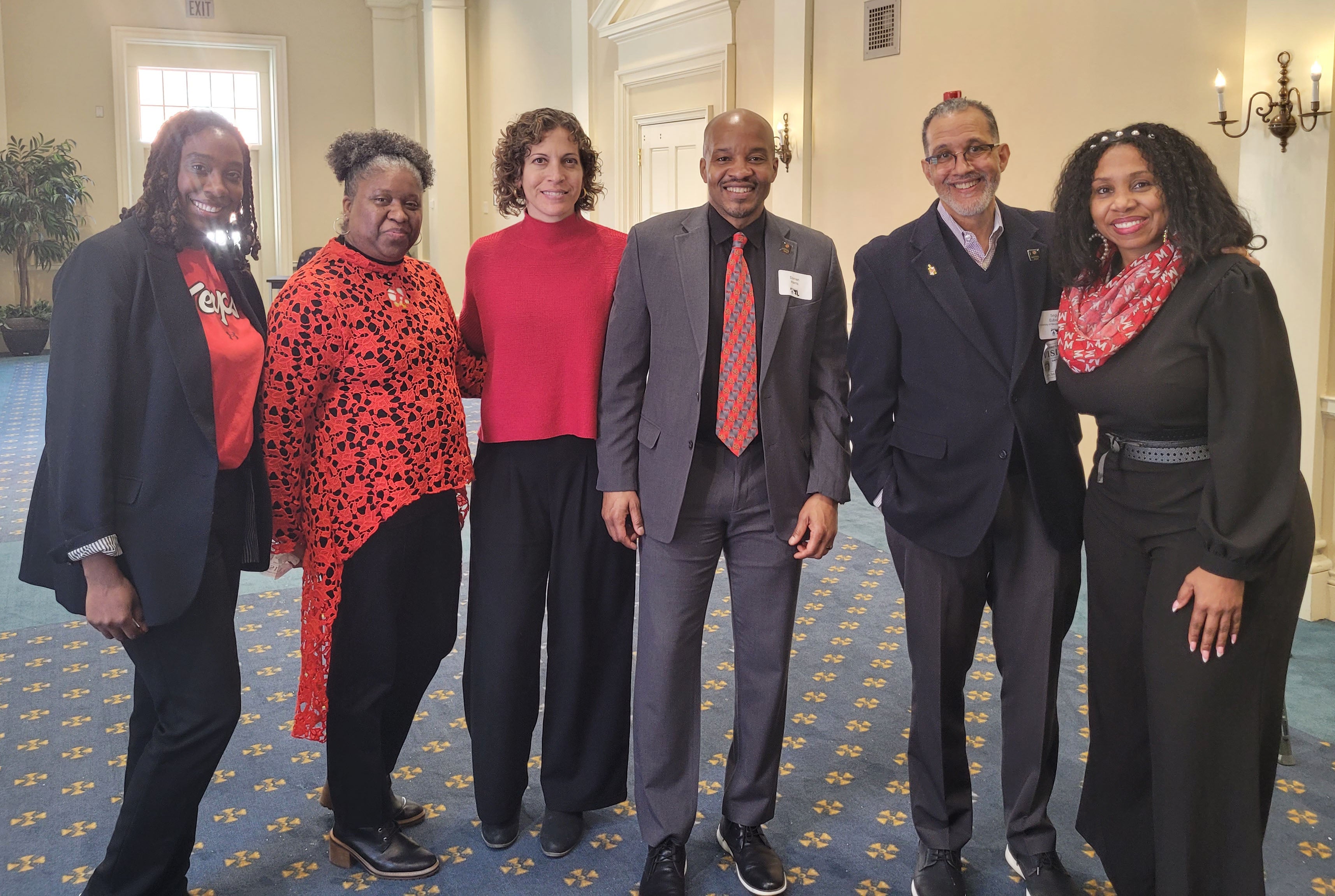
On February 3, six College of Education faculty members, staff members and alums met with 14 state legislators and staff members in Annapolis as part of the Maryland Association of Colleges for Teacher Education (MACTE) Advocacy Day. They discussed issues related to teacher education, including teacher recruitment and retention, mentorship, and financial support for future educators.
MACTE is a statewide professional organization in Maryland that represents colleges and universities involved in educator preparation. It is the state affiliate of the American Association of Colleges for Teacher Education (AACTE).
“EdTerps have had a longstanding commitment to and leadership presence within MACTE. Our continued engagement reflects not only our dedication to educator preparation, but also our belief that advocacy is an essential part of serving schools, communities and future educators across Maryland,” said Ebony Terrell Shockley Ph.D. ’12, associate dean for educator preparation and undergraduate studies and clinical professor. “Our mission calls us to advance equity, excellence and impact through partnership and leadership. Our work with MACTE, including for Advocacy Day, allows us to live out that mission by engaging directly in conversations that shape educational policy, strengthen the educator pipeline and support the success of Maryland’s workforce.”
EMBRACE-MD
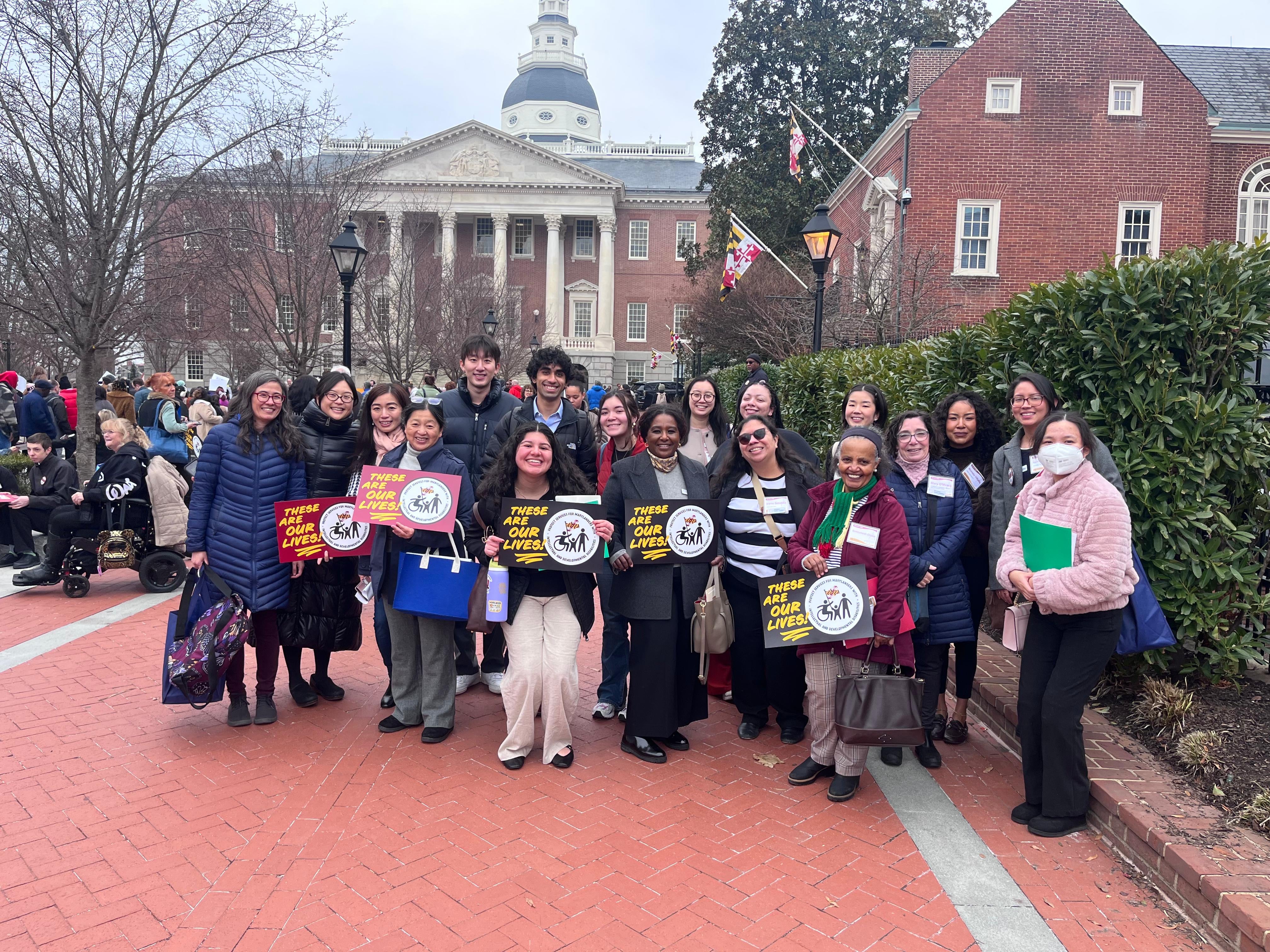
Veronica Kang, assistant professor of special education, facilitates EMBRACE-MD (Enhancing Marylanders’ Sense of Belonging, Knowledge of Rights, and Involvement in Advocacy for Communities of Educators, UMD Students, and Individuals with Disabilities). This student-led, community-based policy research internship strengthens community-led advocacy and improves access to education and support services for people with disabilities and their families.
Through EMBRACE-MD, eight UMD students and one local high school student collaborate with eight of the 39 organizations that are part of the Maryland Equity Coalition for People with Disabilities, led by co-chairs Lisa Lorraine and Ariel La. EMBRACE-MD is funded by a seed grant from UMD’s Institute for Public Leadership.
On Developmental Disabilities Day on February 18, Kang and students and community members from EMBRACE-MD were part of a group of 22 Maryland Equity Coalition for People with Disabilities members that met with state legislators and their staff members in 16 different legislative offices. Coalition members shared personal stories that illuminated the real-world implications of inequities in disability services. They also discussed the need for data transparency from Maryland’s Developmental Disabilities Administration and opportunities for future legislation.
Kang and the EMBRACE-MD students have spent the last year collecting data through observations, interviews and focus groups on how community advocates and families engage in the cultural navigator work. Cultural navigators help individuals with disabilities and their families navigate systems and language and cultural barriers to facilitate access to disability services. They are also advocates, community educators and trust builders. This summer, Kang and the students will conduct a follow-up survey with all 39 organizations in the coalition and additional families and will synthesize and share the results with legislators and community leaders.
“In partnership with the coalition, we are excited to use this data to inform new policies around a sustainable, statewide, cross-disciplinary cultural navigator model,” said Kang.
Federal Advocacy for Special Education and Students with Disabilities
On January 28 and 29, Shanna Hirsch, associate professor, and Kang traveled to Capitol Hill with the Higher Education Consortium for Special Education and met with staff members from the offices of U.S. Rep. Jamie Raskin, U.S. Rep. Steny Hoyer, U.S. Rep. Kweisi Mfume and U.S. Sen. Chris Van Hollen (All D-MD). They advocated for three goals: preserving and expanding programs that support special education doctoral and educator preparation; maintaining and growing federal investment in special education research; and modernizing loan programs to boost educator recruitment and preparation.
On July 13-16, 2025, Kang, special education doctoral student Nay Myo (Chris) Thura and two instructional specialists from Prince George’s County Public School Infants and Toddler Program met with staff from the offices of U.S. Rep. Jamie Raskin, U.S. Rep. Glenn Ivey, U.S. Sen. Chris Van Hollen and U.S. Sen. Angela Alsobrooks (All D-MD), as part of the Council for Exceptional Children’s Special Education Legislative Summit to advocate for students with disabilities, families and teachers. They discussed the educator shortage, teacher recruitment and retention, the need to fully fund the Individuals with Disabilities Education Act (IDEA) and the importance of mental health support and professionals in schools.
Washington Week
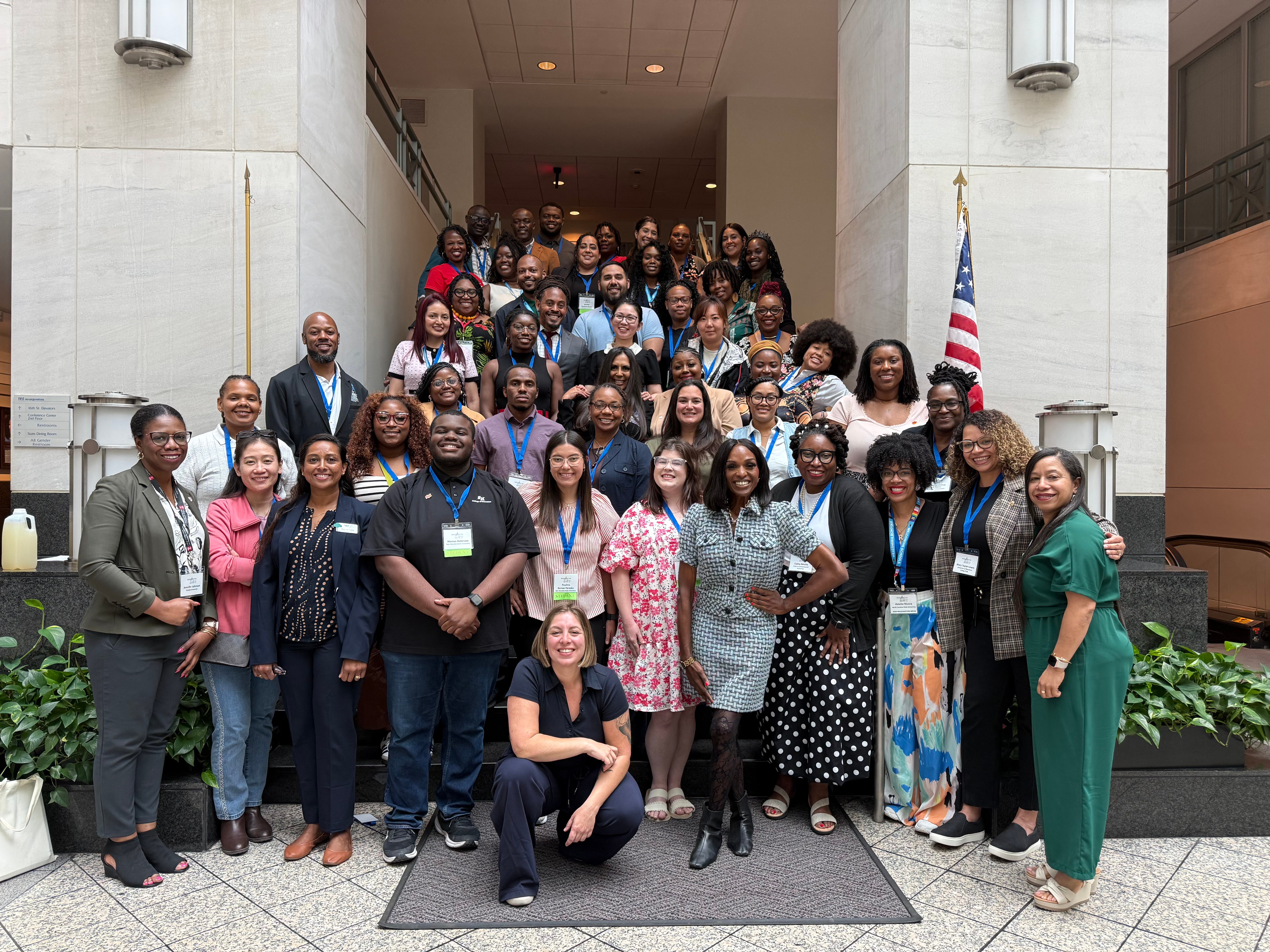
From June 1 to 3, College of Education doctoral student and Holmes Scholar Diamond Emelda Williams and senior faculty specialist and UMD Holmes Scholars Program coordinator Mary Taylor-Lewis participated in Washington Week, a two-day conference to expand advocacy skills in preparation for a day of advocacy entitled Day on the Hill. AACTE partnered with the National Center for Teacher Residencies and Deans for Impact to sponsor Washington Week. (The Holmes Scholars Program is facilitated by AACTE.)
Williams and Taylor-Lewis joined other attendees from Maryland to meet with the offices of U.S. Sen. Angela Alsobrooks, U.S. Sen. Chris Van Hollen and U.S. Rep. Johnny Olszeweski (All D-MD). The collective points of advocacy focused on increased financial support for high-quality teacher preparation and building the educator pipeline. They also met with staff from the Congressional Black Caucus Foundation, the National Education Association and the Brookings Institute to learn about their work and how graduate students can connect with them.
The team from Maryland also endorsed specific legislation to help ensure education is a financially feasible career path, specifically the Professional Student Degree Act (H.R. 6718), Head Start for Our Future Act (S. 2166), Opportunities for Success Act of 2025 (H.R. 6606), TEACH Improvement Act of 2026 (S. 4415) and PATHS to Tutor Act (H.R. 6532). They also advocated for increased funding for IDEA Part D to help address the shortage of special educators.
"Attending Washington Week with AACTE and the Holmes Scholars was an incredibly eye-opening experience,” said Taylor-Lewis. “I was reminded of the power of advocacy in real time. Sitting with staffers and members of Congress days before their appropriations meeting, I had the opportunity to share how their decisions will affect real people—specifically, teachers and students who aspire to become educators.”
AERA Congressional Fellowship

Jeongeun Kim, associate professor of higher education, was named one of two American Educational Research Association (AERA) Congressional Fellows for 2024-25. The AERA Congressional Fellowship Program embeds education researchers in congressional offices and provides them with an opportunity to participate first-hand in the policymaking process and contribute their expertise on issues central to the priorities and agendas of members of Congress.
From September 1, 2024, to August 31, 2025, Kim worked on the staff of U.S. Rep. Suzanne Bonamici (D-OR). Bonamici is a leader on the Education and the Workforce Committee and Ranking Member of the Early Childhood, Elementary, and Secondary Education Subcommittee.
During her fellowship, Kim worked on two bills. The Opportunities for Success Act (H.R. 6606), introduced in December 2025, would update the Federal Work Study Program. The second bill, which has not yet been introduced, would enhance transparency and access to information for students in terms of credit transfer at different institutions.
Kim also drafted a letter to Secretary of Education Linda McMahon and then-Chief Operating Officer of Federal Student Aid Denise Carter to express concerns about the reduction in force at Federal Student Aid and inquire about a plan to move the federal student aid function to the Small Business Administration. The letter was signed by 30 members of the House of Representatives and resulted in a meeting between Rep. Bonamici and Secretary McMahon.
In addition, Kim worked with educational research advocacy groups to write an appropriation letter for the Institute of Education Sciences (IES) in response to the federal government’s abrupt cancellation of research grants. The letter, which emphasized the critical role of educational research in promoting the development and success of all students, received bipartisan support and was signed by 20 senators and 61 representatives. Kim extended her work on the letter by organizing a webinar, attended by about 100 members of Congress and their staff members, where educational researchers and a former IES director discussed the significance of IES and its National Center for Education Statistics and the impact of funding and staff cuts.
“I came to this fellowship believing that rigorous research could make policy better—and that even at a slow pace, better policies could improve the system to give every student a genuine shot, regardless of their background,” said Kim. “Being able to connect research with various legislative efforts was a great experience and a motivator, but I left with a harder question on my mind: how do we restore the public trust and political support for higher education while addressing affordability, access and quality? That’s the work I want to carry forward.”