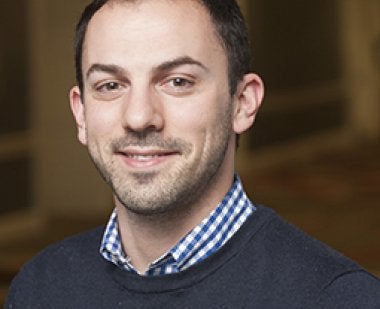
COLLEGE PARK, MD (June, 2016) Stephen Secules, a Ph.D. student in the Curriculum and Instruction program, is the lead author of a paper on the cultural construction of ability in engineering education which won two significant conference awards this April.
At the annual meeting of the American Educational Research Association (AERA) in Washington, D.C., the Learning Sciences Special Interest Group lauded Stephen with its Best Student Paper Award. Then, Stephen traveled to New Orleans to present the paper at the annual conference of the American Society of Engineering Education (ASEE), where it received the Educational Research and Methods Division’s Best Diversity Paper Award. He is now in the running as one of six finalists for the Best Diversity Paper Award across the ASEE conference.
Stephen’s award-winning paper is entitled “‘Turning Away’ from an Undergraduate Programming Student: Revealing Culture in the Construction of Engineering Ability.” The paper’s co-authors are Dr. Andrew Elby (TLPL) and Drs. Ayush Gupta and Chandra Turpen (Department of Physics).
“I first encountered the idea of cultural construction of ability two years ago in an introductory Ph.D. class taught by Dr. Maria Hyler,” Stephen recalls. “It was a very challenging perspective for me to understand at the time, but it came back up several months later when I conducted one-on-one interviews with students who had taken an Introduction to Programming class for electrical engineers. One student told me that he realized he ‘just didn't have the brain for programming.’ I came to understand that he figured that out from certain experiences in the class, from the implicit messages of fellow classmates and the professor, not all of which were necessarily reliable or accurate measures of one's ‘brainpower.’”
“‘Turning Away’ from an Undergraduate Programming Student” draws on a pedagogical theory developed by Dr. Ray McDermott, a professor at the Stanford Graduate School of Education, who asserts that “all educational problems are cultural problems.” This “cultural construction” approach looks at the ways in which many actors within a culture create and perpetuate an educational problem. For instance, in the 1990s, McDermott argued that a “learning disability” was not a property of individual students with intellectual difficulties; rather, he said, “learning disability” was a label constructed by a society and culture of education in which many actors enact, notice, and ascribe the label with meaning. According to McDermott, this type of labeling – and its implicit assumptions about the presence or absence of ability in certain people – obscures the roles other actors play in making labels a reality. Therefore, he advocates that education scholars “turn away” from struggling students and interrogate the cultural processes in which they are immersed.
Stephen says he saw McDermott’s theory play out in the classroom. As he observed the Intro to Programming class over ensuing semesters, he came to view the engineering classroom as a site for constructing and assigning a “lack of ability” in programming and engineering.
“This paper is the first part of an analysis where I look through the lens of ability construction in one student to implicate social labels, classroom arrangements, lecture content and discourse, and lab interactions which were pivotal in this process,” Stephen says. “But in all cases, I try to wonder beyond these local classroom events to the broader educational culture, which has ingrained these practices as the taken-for-granted ways of doing engineering education.”
Stephen intends to keep working in this area as the topic of his doctoral dissertation. His work apparently shows a great deal of promise to other scholars in the field: in addition to the best paper awards, this spring Stephen obtained funding for his research via a Support Program for Advancing Research and Collaboration (SPARC) grant and a dissertation seed grant from UMD’s Consortium on Race, Gender, and Ethnicity.
And in recognition of his impressive scholarship and incredible work ethic, Stephen has also been named the College of Education’s 2016 Outstanding Doctoral Student and an Outstanding Graduate Assistant by the University of Maryland’s Graduate School.
Click here to read Stephen’s award-winning paper at ResearchGate.
Stephen Secules is a doctoral candidate in the Curriculum and Instruction program in the Department of Teaching and Learning, Policy and Leadership. He is a UMD Flagship Fellow. He holds an M.S. in Architectural Sciences from Rensselaer Polytechnic Institute, where he conducted acoustics research in automatic speech recognition and intelligibility, as well as dual bachelor’s degrees in engineering from Dartmouth College.
Dr. Andrew Elby is an associate professor in the Department of Teaching and Learning, Policy and Leadership. Best known for his work on a "resources"-based cognitive model of student and teacher epistemologies, especially in physics education, Dr. Elby has received awards for outstanding mentoring of graduate students from the UMD Graduate School and outstanding refereeing of journal articles from both the American Physical Society and the American Educational Research Association. He holds a Ph.D. in the philosophy of physics from the University of California, Berkeley.
Dr. Ayush Gupta is an assistant research professor in the Department of Physics and a Keystone Instructor in the A. James Clark School of Engineering. Broadly, his research looks at the modeling of learning and reasoning processes, with a focus on how learners emotions couple with their conceptual and epistemological reasoning. Recently, he has examined engineering design thinking and ethics education, as well as the ontological dynamics of students reasoning in physics. He earned his Ph.D. in electrical engineering from the University of Maryland.
Dr. Chandra Turpen is a research assistant professor in the Department of Physics (Physics Education Research Group) and the director of UMD’s Learning Assistant program, which recruits and prepares talented science majors for transforming introductory science courses and pursuing teaching careers. In her work, Dr. Turpen draws on the perspectives of anthropology, cultural psychology, and the learning sciences to focus on the role of culture in science learning and educational change. She completed her Ph.D. in physics, specializing in physics education research, at the University of Colorado Boulder.
Dr. Maria Hyler is a senior researcher at the Learning Policy Institute and an adjunct assistant professor of teacher preparation and professional development in the Department of Teaching and Learning, Policy and Leadership. Her work focuses on structures and systems that support student success, best practices for preparing teachers to teach students of diverse backgrounds, and preparing equity-centered educators. She holds a Ph.D. in curriculum and instruction from Stanford University.
-end-
For more information on the College of Education, visit: www.education.umd.edu
or contact
Audrey Hill, Associate Director of Communications, at: audreyh@umd.edu