In late 2025, there were 117.8 million forcibly displaced people worldwide, including 45 million children, according to UNHCR, the UN Refugee Agency. A complex network of international and local partners provides education in emergencies to these children.
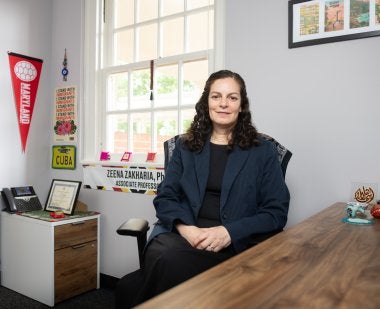
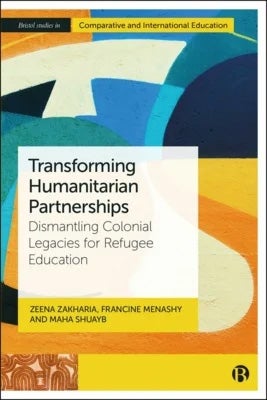
Zeena Zakharia, associate professor of international education policy and Harold R. W. Benjamin Professor in the University of Maryland College of Education; Francine Menashy of the University of Toronto; and Maha Shuayb of the Centre for Lebanese Studies and University of Cambridge, spent nearly a decade researching such humanitarian partnerships, with a focus on the Syrian refugee crisis in Lebanon. In their new book, “Transforming Humanitarian Partnerships: Dismantling Colonial Legacies for Refugee Education” (Bristol University Press), they examine the unequal power structures that they say often undermine the effectiveness of these partners’ work. They also shine a light on a different way to collaborate — where international and local partners build trusting, respectful relationships and create programs that can respond to changing contexts and deliver better outcomes. In an interview, Zakharia discusses some of their main findings and how they can help shape humanitarian education in the future.
Why write a book on transforming humanitarian partnerships in education?
These partnerships are often presented as an unquestioned good. The assumption is that if international and local organizations work together, resources and expertise will be combined, and the response will become more effective.
In our research, we wanted to ask: what happens inside these partnerships, and whose knowledge, priorities and voices actually shape the work?
Humanitarian partnerships often reproduce the very inequalities that they’re intended to address. Our book looks closely at promising partnerships that have created more collaborative, equitable relationships.
If we want refugee education to be sustainable and responsive, we need to pay attention not just to what humanitarian actors deliver but maybe more so to how they work together.
How did you come to research this topic in the context of the global educational response to the Syrian refugee crisis in Lebanon?
Lebanon was an important context because it hosted the largest per capita refugee population in the world, and refugee education involved a remarkably diverse set of actors, including international organizations, United Nations agencies, government bodies, foundations, donors, civil society and schools — working together through what they referred to as partnerships. We combined interviews, ethnographic observation and social network analysis to understand the relationships and structures connecting organizations involved in education and how these partnerships were sustained through crises..
We found that some smaller partnerships were able to adapt and sustain education programs amid these challenges and draw on local knowledge in ways that some larger, more powerful partnerships found difficult to do.
What are some problems with how the humanitarian sector has traditionally operated?
First, the humanitarian sector has historically been characterized by hierarchies of power and knowledge. Organizations based in the Global North (a term used to refer to dominant positions within geopolitical and economic relations) frequently control funding and decision-making, while organizations in the Global South (correspondingly those with marginal status within the global system) are positioned as implementers. The people closest to the problem don’t necessarily have influence over how it’s addressed, even if they hold the most relevant knowledge.
Second, humanitarianism has developed a strong emphasis on efficiency and accountability. This isn't inherently bad, but the problem is when it comes at the expense of relationships, trust, flexibility and responsiveness.
Third, the system often treats externally produced knowledge as more legitimate than knowledge developed through years of working within a community.
Finally, the humanitarian sector hasn’t always adequately confronted the colonial histories and racist structures that continue to shape contemporary aid relationships and influence assumptions about who's capable of leading.
Tell me about one of the promising partnerships you highlight in the book. What makes this partnership effective?
One partnership we highlight was between a refugee-led organization we call Sharaka, which operated nonformal learning centers for refugees, and a Global North organization we call Education Partners. The partnership supported English language skills for refugee teachers and later evolved when Sharaka identified the importance of involving families.
Education Partners didn’t arrive with a predetermined program. The organizations developed the work together, based on needs identified by the refugee teachers. The teachers were considered the leaders and thought partners, not just beneficiaries. They set the goals, developed curriculum and shaped the direction of the partnership.
Effective partnership isn’t about transferring expertise from one organization to another. It’s about co-constructing knowledge and solutions, with both partners recognized as having something important to contribute and learn from the other.
You describe five guiding principles for building more effective partnerships to support refugee education. What are those five principles, and how did you arrive at them?
The five principles are care, trust and respect, communication, mutual learning, and self-reflection. Across our interviews, observations and analysis, we repeatedly saw these qualities associated with relationships that were more collaborative, responsive and sustainable.
We saw care in the ways partners maintained a commitment to the well-being and dignity of the people involved. Trust and respect involved taking seriously the knowledge of local organizations and communities and moving away from constant demands for evidence and instead developing confidence in partners’ expertise and intentions. Frequent open reciprocal communication allowed partners to respond to changing circumstances. Mutual learning challenged the assumption that one partner has the knowledge and the other needs capacity building. And self-reflection emerged as the first step toward ameliorating power imbalances. Importantly, these principles are interconnected and represent practices that can move partnerships away from hierarchical transactions toward more equitable relationships.
These principles aren’t a checklist. The deeper issue is power. Rather than seeing partnership as a mechanism for delivering aid, we can see it as a relationship that requires sharing power, recognizing different forms of knowledge and remaining accountable to one another and communities. That’s the transformation that we’re calling for.
What's next for your work in education in emergencies?
REFRAME (Rethinking Education in Emergencies for Resilience, Action and Meaningful Equity) is an ambitious collaborative project, funded by a Spencer Foundation Vision Grant, which builds on this work in five countries: Bangladesh, Colombia, Nigeria, Somalia and Syria.
REFRAME is trying to build the global education in emergencies system anew from the knowledge, lived realities and aspirations of people most affected by crisis. Over the coming year, we will convene stakeholders around the world to create a transformative vision and develop a research program that will lead to a collective action plan for realizing that vision.