Four College of Education projects are among 18 that will split $245,000 from the University of Maryland’s Do Good Campus Fund.
Now in their third year, the grant awards aim to spark innovative ideas that reimagine learning and strengthen efforts to serve humanity, offering students transformative experiences inside and beyond the classroom. The four College of Education projects were awarded a total of $66,876.
This spring, the Do Good Campus Strategic Leadership Council, in collaboration with Provost and Senior Vice President Jennifer King Rice and the Do Good Institute, awarded the grants to faculty, staff and student groups across nearly every school and college. Arts for All, the presidential campus-wide initiative, contributed $35,000 in arts-related grants, an amount matched by the Do Good Institute.
Over the fund's first two years, grantees have engaged more than 5,000 students in hands-on, experiential learning that connects classroom knowledge with real-world impact, and this year's cohort is poised to go even further.
“In today’s landscape, it’s more important than ever to support experiential education projects that invest in people and communities, partner to advance the public good, take on humanity’s grand challenges and, of course, reimagine learning,” said Do Good Campus Faculty Director James Stillwell. “From student leaders to faculty and staff, this year’s grantees make me prouder than ever to be a Terp. They are fearlessly meeting the moment and showing our campus, our community, and our world what it means to Do Good.”
Grantees will use their award to scale their impact according to the Do Good learning principles: experiential, inclusive, innovative, social impact-oriented and in service of humanity.
The four College of Education projects that received grants are listed below. See the full list of funded projects on the Do Good Institute’s website.
Co-Learn Code and Mind: Empowering Future Innovators through Youth Participatory Inquiry, Social and Emotional Learning, and Intergenerational Mentoring ($19,700)
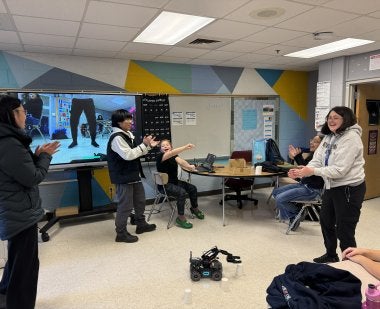
This yearlong afterschool program, a partnership between UMD and Montgomery County Public Schools, uses robotics as a platform for hands-on learning and student-led exploration. The project now aims to expand into additional MCPS middle schools; funding will support pilot schools as they launch and transition to self-sufficiency. The program centers students’ voices through reflection and collaboration, helping participants build confidence, communication skills and a sense of belonging, while connecting UMD students, high school mentors and senior volunteers in a supportive, cross-generational learning community.
Stepping up for Sustainability: An AGNR & CYC Collaboration ($18,000)
This project addresses severe erosion on the College of Education’s Center for Young Children playground while providing hands-on learning for students in the College of Agriculture and Natural Resources course INAG251: Landscape Construction. Working in collaboration with the College of Education, students will survey, design and build a functional playground for young children, gaining practical skills in landscape construction, teamwork and project management. The project serves as a model for integrating real-world environmental solutions with workforce-focused education. Funding will support direct construction costs.
The Thriving Project: UMD Black Male Undergraduates Mentor Black Boys in Local School Districts to Cultivate Access, Belonging, and Success on Campus ($15,500)
This project brings together Black male students at UMD to serve as mentors and role models for Black boys in local middle and high schools, creating supportive pathways from K-12 to college and strengthening belonging and success for Black male undergraduates. Funding will support mentorship coordination with partner school districts, original photography projects exploring what it means to thrive in educational spaces, and program activities and shared meals that foster authentic connection.
Drawn Together: A Bilingual Digital Storytelling Project ($13,676)
This project brings UMD teacher candidates and College Park Academy students together to address the underrepresentation of Latino voices in children's literature through bilingual digital storytelling. Funding will support early field experiences for teacher candidates and project implementation through the College Park Academy afterschool program.
Photo: Students at A. Mario Loiederman Middle School cheer as they test the robot they built at the UMD-MCPS afterschool program Co-Learn Code and Mind.
This story is adapted from an article that first appeared in Maryland Today.