Even my community service and extracurricular activities involved service, and international education and community involvement. I was working and studying at the same time, but I was also acting as the Community Development Coordinator on the Graduate Student Council at SIS. Working on the Graduate Student Council (GSC) at American University (AU), I created 9 Programs Student Associations for the SIS Graduate programs to streamline communication and advocacy between all SIS students, their programs, and the GSC. I also worked with 12 MA Programs and over a hundred students to create a safe and inclusive environment within the AU community through community building, student development activities and events. My constant focus has been to help others.
My research and capstones involved studies of East Asia, international education and exchange, peace education, and public diplomacy. Based on my research, work experience, and what I am studying, I chose to go to the University of Maryland (UMD) to study in the International Education Policy Program. As stated on the International Education Policy (IEP) website, “The program is a collaborative community that develops theory, conducts research and translates these into practice, and engages students, educators, and professionals in the advancement of education.” I want to be able to develop theory, conduct research, and translate my research into practice. My PhD advisor is Dr. Taylor Woodman, whose research is in global learning and academic diplomacy. Until very recently, Honduras was one of the last remaining Latin American countries that recognized Taiwan, and in part, it is due to the amount of funding (scholarships and infrastructure) that China has given to Honduras. This is of interest to me on a personal level as well, due to my family being from Honduras. I am interested in understanding how various developed countries (especially China) have influenced education in Latin America (i.e. Honduras) through scholarships and study abroad programs. My research interests are in understanding the connection between international education/exchange and public diplomacy which I believes is important for creating peace and understanding in our world, which starts with helping students to gain global learning opportunities.
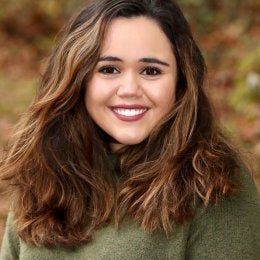
Marci Falck-Bados is an Administrative Coordinator for the Office of Global Engineering Leadership as of May 2026, where she supports Maryland Engineering Student Organizations (MESO) and study abroad programs. Prior to joining OGEL, Marci worked for American Councils for International Education on three different U.S. State Department study abroad scholarships for high school students: NSLI-Y, YES Abroad, and FLEX Abroad. Marci grew up in the area and has spent most of her life living in Montgomery County, MD. She graduated from Texas A&M University in 2018 with a BA in International Studies and a double minor in Mandarin and Psychology. She returned to the D.C. area to pursue an MA and earned her degree in 2020. During this time, Marci worked as an early childhood education and English Language learning (ELL/ESOL/ESL) teacher. She continued with her education and graduated from American University in May 2022, where she earned an MA in International and Intercultural Communication. Marci is currently working on her PhD in International Education Policy and is a proud Terp!
LinkedIn: https://www.linkedin.com/in/mfalckbados/
Hans "Tom" Tuch Fellowship 2021-2022: https://www.publicdiplomacy.org/fellowships_and_internships.php
American University
- American University School of International Service (SIS): Student Award for Outstanding Voluntary Service and/or Activism On-Campus, Issued by American University School of International Service · May 2022 · https://www.american.edu/sis/news/20220502-sis-awards-2022.cfm#graduateawards
- Akram R. And Lourdes P. Elias Scholarship, Issued by IC Program, School of International Service · May 2021 · Scholarship for the commitment to the field of intercultural communication at American University’s School of International Service Intercultural Communication (IC) Program
- SIS Dean’s Award, Issued by American University · Jun 2020 · This was a scholarship given to students who were AmeriCorps Volunteers and received outstanding academic achievement
Relay Graduate School of Education
- AmeriCorps Segal Education Award, Issued by AmeriCorps and Relay Graduate School of Education · Sep 2018 · This scholarship was given to me for two school years: 2018-2019 and 2019-2020
Capstones and Projects
My capstone in undergrad looked at a literary comparison of a Chinese feminist author and of a Latina feminist author, Isabel Allende. The project discussed the similarities and differences of their styles of work and their commentary on their respective cultures in regard to gender and gender equity.
When I was at American University’s School of International Service (SIS), my focus at SIS was on Transnational Education and Public Diplomacy. I took multiple courses on intercultural communication, international education and exchange, cultural diplomacy, a capstone, and a semester-long independent study. My capstone allowed me to work with a nonprofit organization, the Euphrates Institute, that focuses on peacebuilding. We created a training manual that they use for their training and workshops, specifically their Peace Practice Alliance Program. I led a team of 4 in the creation of the +100-page peace leadership training manual, which was a deliverable for the Euphrates Institute.
I completed my independent study under the guidance of my faculty advisor and professor for many courses, Dr. Naomi Moland. The culmination of the course was a Substantial Research Paper (SRP), i.e. a mini–master’s thesis. My SRP focused on how U.S. non-state actors use teacher exchange programs and education as a public diplomacy tool to impact pedagogies, thus creating opportunities to change student worldviews and teach democratically connected values. My research for this course focused on:
examining the role of education in fostering or hindering economic, political, and social change at different levels, as well as barriers to promoting educational development (access, quality, equity, and inclusion) by applying a critical lens to contemporary social and political dimensions of transnational education and identities.
- Identifying the context, actors, drivers, and cultural landscape(s) shaping international education, understanding the key theoretical frameworks and vocabulary that underpin the international education exchange field.
- Learning about a variety of international education exchange systems throughout the world and the complexities and unique features of each system.
- Examining power relationships between different actors involved in cultural diplomacy, including governments, corporations, civil societies, and the general publics.
- Weighing different perspectives on the key debates about cultural diplomacy, including debates about whether such efforts are salutary or forms of propaganda.
- Investigate the strategies of cultural diplomacy by identifying the actors involved, the medium used, the goals, the messages, the (intended) audiences, potential challenges, and the efficacy.