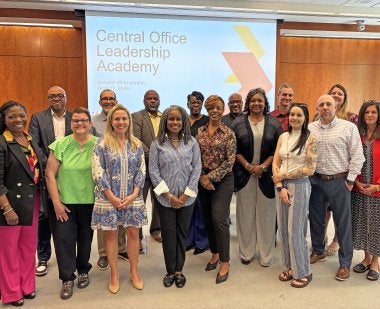
The Center for Educational Innovation and Improvement (CEii) at the University of Maryland College of Education has launched a new signature professional development program to help school district leaders based in central offices address complex problems. Through the first Central Office Leadership Academy (COLA), teams from four Maryland public school districts learned about leadership development and chose a problem of practice to explore and address over a six-month period, from November to April.
“Quite often, school district leaders in central offices are the ones helping deliver the professional learning, looking for funding for it, communicating about it or finding employees to benefit from these unique experiences—but they are rarely the recipients,” said Douglas W. Anthony ’92, M.Ed. ’01, Ed.D. ’16, a senior fellow at CEii and co-lead of COLA along with Monifa McKnight Ed.D. ’14, visiting professor. Segun Eubanks Ed.D. ’12, director of CEii and professor of practice; and Damaries Blondonville, a CEii program fellow, help to facilitate the program, which also hosts guest expert speakers at each session.
“The facilitators are distinguished educators and researchers who have lived in the work in this career field,” said Tracie Malone, director of talent acquisition and management at Prince George’s County Public Schools and a member of the first COLA cohort. “They are able to not only bring their own career knowledge and skills to the leadership program but also their personal experiences.”
In addition to the Prince George’s County team, the first COLA cohort comprised teams representing Anne Arundel, Dorchester and Calvert Counties. Each team included up to five participants, who hold a range of roles in their school districts’ central offices.
Participants met once a month for six all-day sessions, three in-person and three virtual. During the sessions, they explored individual leadership, including learning to examine their own identities as leaders, their strengths and potential areas for growth, and their ability to lead others and practice self-care. They also focused on issues related to organizational leadership, including how to support their districts’ priorities and how education policy and challenges like teacher retention, chronic absenteeism and mental health affect their districts.
The problems of practice that the participants selected are long-standing, complex “wicked problems” that do not have simple solutions. In the first cohort, the district teams grappled with making internal communications more clear and consistent; standardizing teacher evaluations to make them more accurate and useful; improving efficiency and responsiveness in human resources; and closing an academic performance gap between students with disabilities and all students.
Each team identified conditions contributing to their problem of practice and proposed key changes that could lead to real improvement. The district teams each met with one of the four facilitators from the CEii team, who coached them through the process. To understand and improve these problems, the teams worked on conducting surveys, convening focus groups and task forces, upgrading district websites and resources, developing professional development opportunities and working to fill vacancies.
“[COLA] is a unique blend of research and direct work with the researchers and practitioners. We were really able to dive into the improvement process and engage in some of that direct application of the work to the problems of practice we’re facing in the district,” said Lisa Yankanich, supervisor of student services at Calvert County Public Schools. “It is an amazing opportunity to connect with other districts, to talk through problems of practice, to network and to have the guidance, coaching and consultation from the CEii team.”
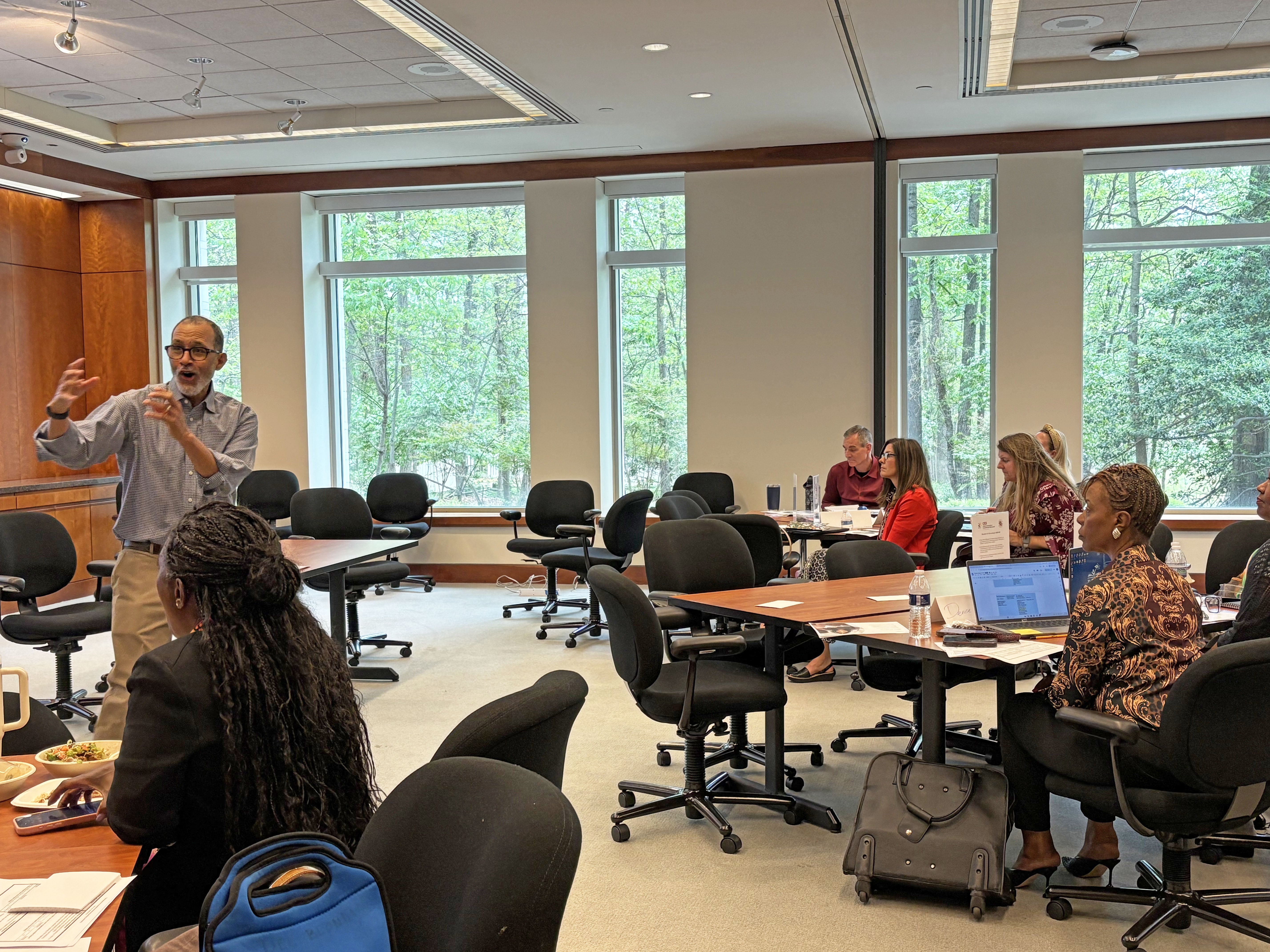
CEii’s work is grounded in improvement science and the idea that continuous improvement is possible, even for problems that are not easy to solve.
“We want people to wrestle and grapple with the problem longer than they tend to spend finding a solution,” said Anthony, who developed a similar leadership academy for central office staff in Prince George’s County Public Schools in his former role as an associate superintendent. “Improvement science makes you really study and understand the problem. We’ve taught [COLA participants] many elements of improvement science so that they can find strategies that support them in unpacking and figuring out the problems of practice that they bring to the table.”
For example, one of the six core principles of improvement science involves looking at the whole system that produced the current outcomes. Anthony pointed out that central office employees are well positioned for this work, as they are responsible for serving an entire school district, yet they may tend to operate in silos. Through COLA, participants gained language and skills to increase collaboration and serve schools more efficiently and effectively.
COLA is a core element of the UMD School Improvement Network, recently launched by CEii. The Network is a community of practice that offers school and district leaders the opportunity to share strategies and resources and to learn from leaders in other districts who face similar challenges. The Network offers access to workshops, webinars, leadership coaching and problem-of-practice groups. Members receive discounts to programs including COLA and CEii’s School Improvement Leadership Academy, as well as online courses and microcredentials.
The Network recently received a Research Resilience Initiatives Preserve, Pivot, & Grow Program award from UMD, which supports CEii’s current work to build an infrastructure to scale continuous improvement across Maryland. CEii plans to add additional asynchronous courses, microcredentials and targeted seminars.
“With the Network, we are building a collaborative ecosystem to help leaders solve complex problems in real time,” said Cherise J. Hunter ’01, M.Ed. ’02, Ph.D. ’11, a fellow at CEii, who is coordinating the UMD School Improvement Network 2026-27.
“CEii is more than professional development,” said Eubanks. “We use research-practice partnerships to connect with school districts and develop improvement leaders. We build the capacity of school and system leaders to be solution architects. Moreover, we create the place and space for education leaders to learn from other leaders across Maryland’s school districts.”
The UMD School Improvement Network 2026-27 interest form is now open. Registration is also open for CEii’s annual summer conference, titled Courageous Leadership, Ambitious Improvement, Greater Impact, which will be held at the College Park Marriott Hotel & Conference Center, June 24-26.
Information about how to register for next year’s COLA will be available on the program’s webpage.