

Multilingual Research Center (MRC)
Applied Linguistics & Language Education Forum
The ALLE Forum is a space for ALLE faculty and doctoral students to share and discuss their recent scholarship with the broader ALLE community. We invite members of the ALLE community to sign up to present their work, either individually or with co-presenters. Presentations may focus on polished work or on works-in-progress and may cover a broad range of topics relevant to the ALLE research community. Presentations should be approximately 45 minutes in length, plus 15 minutes for Q&A. The ALLE Forum takes place from 1:00-2:30pm on the first Friday of most months throughout the fall and spring semesters.
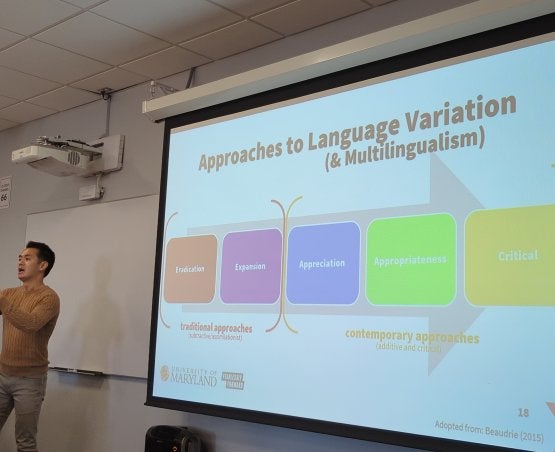
There are currently no upcoming ALLE Forum events. Please contact Katie Glanbock (glanbock@umd.edu) if you are an ALLE doctoral student or faculty member interested in presenting.
What do Ghanaian Teachers Think About the Language-in-Education Policy in Ghana?
Exploring Teachers' Attitudes, Practices, and Perceptions
Dr. Shenika Hankerson and Monica A. Obiri-Yeboah
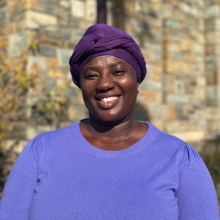
Teachers’ attitudes toward language-in-education policies influence not only their instructional decisions, but also students’ language experiences and educational outcomes. Exploring teachers’ attitudes is therefore critical if we aim to understand how language-in-education policies are enacted in practice and how they impact student learning. This qualitative case study explores Ghanaian teachers’ attitudes, practices, and perceptions toward the language-in-education policy in Ghana. It employs semi-structured interviews to capture the rich and nuanced experiences of primary school teachers at a public school located in the Effutu Municipality in the Central Region of Ghana, seeking to understand why they hold certain attitudes toward the policy, and how their ideological beliefs influence their policy interpretations and implementations. Findings show that the teachers’ attitudes, practices, and perceptions are influenced by a combination of personal, institutional, and sociopolitical factors that shape how they interpret and apply the policy. This study offers valuable insights into what pre- and in-service teacher education programs in Ghana can do to help primary school teachers develop an accurate understanding of the policy and cultivate anti-colonial language ideologies that affirm Ghanaian students’ multilingual identities. Implications are discussed for practice, policy, and future research.
Exploring the Identities of Transnational Chinese and Spanish Language Teachers from Critical Perspectives

By Xinhang Hermione Hu, Mariana Sánchez and Dr. Kellie Rolstad
This study explores how transnational Chinese and Spanish language teachers navigate, negotiate, and reclaim their professional identities across national borders and educational systems. Despite their rich multilingual and multicultural experiences, these teachers often encounter misrecognition, marginalization, and tensions between their internal identities and external perceptions. Guided by Olsen’s (2016) theory of teacher identity, a dialogical approach (Akkerman & Meijer, 2011), and Palmer et al.’s (2019) framework of critical consciousness, we conducted a narrative case study (Clandinin & Connelly, 2000; Sonday et al., 2020; Stake, 1995) incorporating pláticas (Flores & Morales, 2021) and arts-based methods (Leavy, 2022). Data included demographic surveys, interviews, plática (conversation), drawings, and audio narratives from two multilingual female teachers: Daniela, a Puerto Rican, Lebanese, American former dual language educator, and Lan, a Chinese foreign language teacher. Findings reveal four interconnected themes: (1) navigating tensions between self-identity and external perceptions, (2) negotiating legitimacy and belonging across transnational contexts, (3) reclaiming linguistic and cultural identities through reflective practices, and (4) validating their experiences through collective reflection. Participants described how linguistic, racial, and cultural assumptions in U.S. schools shaped their confidence and sense of qualification, yet through reflection, they reframed their identities beyond binary national categories toward a transnational lens. This study highlights the need for teacher education and professional development to intentionally support transnational teachers' identity work, critically engage differences in race, language, and culture, and create relational spaces for collective reflection that affirm the complexity of teachers' lived experiences.

Linguistic Justice and Heritage Language Rights: Engaging Student Teachers with a Holistic Approach to Multilingual Education
A Practice Academic Job Talk by John Chi
For this month's ALLE Forum, John Chi will be giving a practice job talk for a position as 'Teacher Educator for Multilingual Learner Education,' as a part of an on-campus interview process. During this presentation, John will share about his scholarly works and how they each connect to multilingual education broadly, interweaving their relevance to this particular teacher education position. This is an opportunity for John to refine his job talk presentation, as well as for audience members to provide support, learn more about the job talk process, and give productive feedback.

A Novice DLBE Teacher’s Journey to Developing Authentic and Responsive Spanish Literacy Instruction Through Dialogic Coaching Grounded in Cariño
By Mariana Sánchez & Sandra Gutiérrez
As dual-language bilingual education (DLBE) programs continue to expand across the U.S., teachers face an increasing pressure to use monolingual English approaches to literacy instruction (Goldenberg, 2020; Hopewell et al., 2016). Within this context that neglects Spanish literacy, our team found that DLBE teachers were seeking support for how to implement authentic Spanish literacy instruction. In an attempt to disrupt English hegemony, our team designed an instructional protocol based on Spanish literacy development that includes phonics, vocabulary development, interactive reading, dictado and oracy. This case study examines how, aided by this protocol and Latina-to-Latina coaching grounded in cariño (Garcia Ybarra et al., 2024), a novice first-grade Dominican DLBE teacher learned to teach Spanish literacy more holistically and authentically. Our findings demonstrate that dialogical coaching cycles that attend to the assets and needs of a novice teacher and her students can help teachers develop a deeper understanding of Spanish literacy, asset-based pedagogies, and improve students’ oracy development and engagement.
Supporting a DLBE Latina Leader Through Holistic and Culturally Affirming Coaching Pláticas
By Astrid Sierra & Sandra Gutiérrez
DLBE school leaders not only need a deep understanding of how to promote high quality bilingualism/biliteracy instruction, but also to engage in “courageous leadership” (Souto-Manning et al., 2016) to combat injustices and center the needs and gifts of racialized Emergent Bilinguals (EBs). Although coaching has emerged as a promising strategy to support leaders’ learning and work (Shoho et al., 2012), there are no studies to date exploring how to coach Latine school leaders of bilingual schools in ways that are holistic and culturally affirming. This case study addresses this gap in the literature by shedding light on how leadership coaching pláticas, grounded in Latinx/Chicanx feminist theory, can provide a dialogical space for a Latina bilingual school leader to reflect and grow. Our analysis uncovered that the Latina leader experienced two important shifts: heightened asset-based mentality and awareness of inequities, and integration of reflective practices to build capacity and collaboration. Additionally, our findings discuss distinct coaching pláticas practices that supported these shifts.

Using Core Practices for Teaching MLLs to Support Teachers’ Humanizing Understandings
By Dr. Megan Madigan Peercy & Jessica Crawford
In this presentation, we share our current work exploring the potential and limitations of our core practices to support a variety of teacher populations developing their humanizing practice with MLLs. We detail the core practices and related resources we have developed, as well as our emerging research on how core practices may work in conjunction with teachers' emerging humanizing understandings (HUs) to support teachers' developing humanizing pedagogy. We will discuss how we are developing these HUs in our MLL methods courses and the potential of HUs to support humanizing praxis in our broader teacher preparation efforts.