The Maryland Initiative for Literacy & Equity (MILE)
Literacy Research Symposium
MILE’s Literacy Research Symposium showcases interdisciplinary and translational language and literacy research done by students and faculty at UMD and our partner institution, Morgan State University.
Click to interact with our photo galleries!
2025

2026

February 13, 2026 • Morgan State University Campus
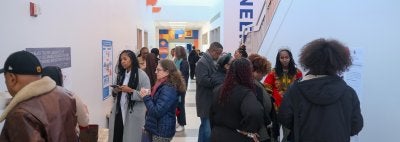
MILE hosted the second Literacy Research Symposium alongside the National Center for Elimination of Educational Disparities (NCEED). The event hosted 75 attendees from Morgan State University, University of Maryland and community partners at Morgan State University’s Schaeffer Building. The agenda showcased research updates from the 2025 Seed Grant winners, Dr. Bryan Best and Dr. Wang, Dr. Ortiz and Dai, and research proposal presentations from the year’s graduate and faculty awardees: Olisa Menakaya, Dr. Krishna Bista, Drs. Ana Ndumu and Cécile Accilien, and Annie Karabell.
Keynote Speaker: April Baker-Bell, Ph.D.
About the Workshop:
This interactive workshop supports participants in exploring ways to integrate the principles of Linguistic Justice into curriculum and instruction. The session will include guided, activity-based exercises such as reflection and preflection activities, syllabus design, and instructional strategies. Participants will also receive a digital workbook to support continued learning beyond the workshop.
About the Speaker
Dr. April Baker-Bell is an Associate Professor of Language, Culture, and Justice in Education in the Joint Program in English and Education and Educational Studies at the University of Michigan Marsal Family School of Education. A former high school English teacher and graduate of the Detroit Public Schools Community District, her research is situated at the intersections of Black Language and literacies, anti-Black racism, and antiracist /pro-Black language pedagogies.
Dr. Baker- Bell is an international leader in conversations on Black Language education, and her multi award-winning book, Linguistic Justice: Black Language, Literacy, Identity, and Pedagogy, brings together theory, research, and practice to dismantle Anti-Black Linguistic Racism (a term Baker-Bell coined) and white linguistic supremacy. The book provides ethnographic snapshots of how Black students in Detroit navigate and negotiate their linguistic and racial identities across multiple contexts, and it captures what Antiracist Black Language Pedagogy looks like in community with Black youth. Linguistic Justice features a range of multimodal examples and practices through instructional maps, charts, artwork, and stories that reflect the urgent need for antiracist language pedagogies in our current social and political climate.
Her latest research project, which was funded by the Andrew W. Mellon Foundation, involves collaborating with healthcare scholars and researchers to develop, implement and study antiracist medical curriculum interventions that support healthcare professionals with developing an antiracist praxis for confronting and reducing racial bias and anti-Black racism in medical and healthcare institutions.
Dr. Baker-Bell is the recipient of many awards and fellowships, including the 2023 Michigan Council of Teachers of English’s Charles Carpenter Fries Award, the 2021 Coalition for Community Writing Outstanding Book Award, the 2021 Andrew W. Mellon Foundation’s New Directions Fellowship, the 2021 Michigan State University’s Community Engagement Scholarship Award and the 2021 Distinguished Partnership Award for Community-Engaged Creative Activity, the 2020 NCTE George Orwell Award for Distinguished Contribution to Honesty and Clarity in Public Language, the 2020 Theory Into Practice Article of the Year Award, the 2019 Michigan State University Alumni Award for Innovation & Leadership in Teaching and Learning, the 2018 AERA Language and Social Processes Early Career Scholar Award, and many more.
Prior to joining the Marsal Family School of Education, Dr. Baker-Bell was an Associate Professor of Language, Literacy, and English Education at Michigan State University. She was affiliated with the English Education program, the Department of African American and African Studies, and the Center for Bioethics and Social Justice in the College of Human Medicine.
Schedule
10:00 AM - 11:00 AM: Check-In & Student Posters
Grab your name badge before the event begins and check out some student posters!
11:00 AM - 11:30 AM: Updates from 2025 Faculty Seed Grant Winners
Our 2025 Innovation Seed Grant winners will provide an update on their funded projects.
- Change the Game: Gaming as a Gateway to Literacy for Black Students
Dr. Bryant Best - Sequential Organization in Literacy Skills: Does Perceiving Visual-Orthographic Patterns Enhance Second Language Word Writing?
Dr. Min Wang, Dr. Jose Ortiz, and Yi Dai
11:30 AM - 12:00 PM: 2026 Graduate Student Seed Grant Winners
Hear from our 2026 Graduate Student Seed Grant winners from Morgan State University and the University of Maryland.
- Alignment by Design: The Effects of an Aligned Instructional Model on 2nd Grade Reading
Annie Karabell - Time to Save Our Oceans: A Higher Education Literacy Pilot
Olisa Menakaya - Bridging Cultures and Building Literacy: Community-Centered Approaches for Black and Brown Children in Baltimore
Dr. Krishna Bista - Konesans Together Project
Drs. Ana Ndumu and Cécile Accilien
12:00 PM - 1:15 PM: Networking Lunch
Enjoy catered lunch with time to connect with colleagues.
1:20 - 2:20 PM: 2026 Faculty Seed Grant Winners
Faculty from Morgan State University and the University of Maryland, College Park will share their winning proposals from this year's Faculty Seed Grant competition.
2:30 - 4:00 PM: Workshop with Dr. April Baker-Bell
Enjoy a workshop with keynote speaker Dr. April Baker-Bell on language justice in coursework.
About the Presenters
Alignment by Design: The Effects of an Aligned Instructional Model on 2nd Grade Reading • Annie Karabell
In this presentation, Annie Karabell will provide an overview of the implementation of an aligned instructional model in which eight classroom teachers and three intervention teachers provide instruction that is consistent in content, instructional routines, language, and skills. She will also discuss the observation fidelity measures, the approach to measuring cross-grade alignment, and the interrupted time series design.
Time to Save Our Oceans: A Higher Education Literacy Pilot • Olisa Menakaya
This seed grant project explores how AI-assisted interactive modules can strengthen climate literacy in higher education. In Time to Save Our Oceans, undergraduates use game-informed activities, local climate scenarios, and simulated environmental data to build sensemaking, climate vocabulary, and evidence-based reasoning. Using pre-intervention and post-intervention survey results, student responses, and interaction analytics, the project evaluates effects on understanding, confidence, and civic agency and identifies scalable, low-cost strategies for implementation in diverse classroom settings.
Bridging Cultures and Building Literacy: Community-Centered Approaches for Black and Brown Children in Baltimore • Dr. Krishna Bista
This session will share a community-engaged literacy initiative designed to support Nepalese-American and African American children in Baltimore through bilingual, culturally responsive family literacy practices. Drawing on long-standing research in literacy and educational equity, the session highlights how home-based reading, digital storytelling, and community partnerships can address structural literacy inequities while leveraging multilingualism and cultural strengths.
Konesans Together Project • Drs. Ana Ndumu and Cécile Accilien
Dr. Ana Ndumu and Dr. Cecile Accilien from the University of Maryland in partnership with the Haitian Development Center of Delmarva are leading the Konesans Together (KT) Project, a collaborative initiative designed to boost critical literacy and information skills within Wicomico County’s Haitian community. Using a participatory action research model, the project empowers youth ages 8–14 to co-create multiliteracy resources, including publishing their own creative works and expanding Kreyòl language collections at local libraries. By hosting workshops and fostering community engagement, the initiative aims to reduce reading inequities and establish a sustainable framework for family literacy.
February 26, 2025 • Maryland Language Science Center at the University of Maryland
2130 HJ Patterson Hall, College Park, MD 20742
Schedule
- 12:00 PM - 1:00 PM: Appetizers & Welcome
Remarks by MILE directors Dr. Simone Gibson and Dr. D.J. Bolger - 1:00 PM - 1:30 PM: Seed Grant Presentation
Sequential Organization in Literacy Skills: Does Perceiving Visual-Orthographic Patterns Enhance Second Language Word Writing?
Min Wang, Ph.D., José Ortiz, Ph.D., & Yi Dai - 1:30 PM - 2:30 PM: Lunch & Student Posters
- 2:30 PM - 3:00 PM: Seed Grant Presentation
Change the Game: Gaming as a Gateway to Literacy for Black Students
Bryant O. Best, Ph.D. & Tarrin Morgan, M.A.S. - 3:00 PM - 4:00 PM: Keynote Presentation
Promoting Literacy through Language with Dr. Rebecca Silverman
Keynote Speaker: Dr. Rebecca Silverman
Rebecca D. Silverman is the Judy Koch Professor of Education at the Stanford Graduate School of Education (GSE). She began her career in education as an elementary school teacher. Dr. Silverman’s research focuses on language and literacy development in early childhood and elementary school. Her work has contributed to the research base on supporting vocabulary and other aspects of language that are critical to reading and writing and using multimedia and educational technology to facilitate literacy. She is involved in projects related to language-based instruction for multilingual learners, computer-adaptive assessment of language and literacy skills, and the effectiveness of a supplemental digital literacy program. Dr. Silverman leads the Language to Literacy Research Lab and is engaged in research-practice partnerships in the San Francisco Bay Area.
About the Presenters
Min Wang, Ph.D. • Professor, UMD College of Education
Dr. Min Wang received her Ph.D. in Applied Cognitive Science from the University of Toronto in 2000. Upon graduation she completed her post-doctoral training at the Learning Research and Development Center at the University of Pittsburgh, funded by a fellowship from the Social Sciences and Humanities Research Council of Canada. She became a member of the Faculty of Human Development at the University of Maryland in 2002. Dr. Wang’s research interests are in the area of language and reading development. Specifically, she is interested in how cross language and writing system differences impact learning to speak and read in a first and second language. Her recent work has mainly focused on Chinese-English, Korean-English, Spanish-English bilingual children and adults, funded by NIH/NICHD, NSF, and Spencer Foundation. Dr. Wang is also interested in extending her work to other bilingual populations involving various languages and writing systems in the world. Dr. Wang has been serving on the editorial boards of Applied Psycholinguistics, Writing Systems Research, Contemporary Educational Psychology, and International Multilingual Research Journal. She has served as the Director of Graduate Studies in her department and the Executive Committee of the NSF-IGERT program at the University of Maryland in Biological and Computational Foundations of Language Diversity. She is a . For a complete CV please contact Dr. Wang at minwang@umd.edu, or see Dr. Wang’s personal webpage at www.education.umd.edu/HDQM/Wang-lab/ for more information about her recent work and publications.
José Ortiz, Ph.D. • Associate Director of Outreach, MILE
José A. Ortiz is an Assistant Professor in Hearing and Speech Sciences, at the University of Maryland, College Park. He serves as the director of the Language Diversity Lab and the Certificate in Bilingual Speech-Language Pathology. He received a B.A. in Linguistics & Psychology from the University of Connecticut in 2004, M.A. in Speech-Language Pathology from the University of Massachusetts Amherst in 2007, and Ph.D in Special Education from the University of Maryland, College Park in 2022. As a speech-language pathologist, José has focused on providing services to Spanish-speaking communities in the US. His research is centered on issues relating to the identification of language-related disorders in bilingual children, including disproportionality in special education, equitable access to education services, non-biased assessment, and technology-enhanced assessment and intervention. CV: http://joseaortiz.com/cv • Personal Website: https://www.joseaortiz.com
Yi Dai • Ph.D. Student, UMD Department for Human Development and Quantitative Methodology
As of 2025, Yi Dai is a second-year doctoral student in Human Development (HD) program at the University of Maryland, College Park, and serves as the HD graduate representative for 2024-2025. She earned an M.S. in Cognitive Science with a minor in Linguistics from the University of Minnesota, Twin Cities, in 2023. Prior to that, she was a lecturer teaching Chinese as a second language for four years at the Nanjing Medical University in China. Her research interests primarily focus on second language acquisition, cross-language transfer, and language production development.
Bryant O. Best, Ph.D. • Assistant Professor, Urban Educational Leadership, Advanced Studies, Leadership & Policy at Morgan State University
Bryant O. Best, son of James W. Best and Annie Beatrice Newsome, was on born October 31st ,1989. Raised in Wilson, NC, Bryant’s mother instilled in him a passion for reading and knowledge that molded him into the man he is today. His career began as an intern for the American Council on Education’s (ACE) Center for Policy Research and Strategy (CPRS). There, he analyzed and reported on national and institutional level data in response to pressing issues in higher education, produced briefings for college and university leaders on the matter ofeducational equity, and established a research partnership between the CPRS and the National Collegiate Athletic Association (NCAA) that resulted in a publication on the academic and social experiences of Black male Division I athletes. Similarly, in his role at the Council of Chief State School Officers (CCSSO), Bryant worked with six to eight state education agencies that were committed to the Innovation Lab Network (ILN) and its principles of educational equity, personalized learning, socioemotional learning, and competency-based education.
Research Interests: One area of Bryant’s research agenda highlights the policies and practices that contribute to the school discipline disproportionality – what some scholars refer to as the “school-to prison pipeline” – with a particular focus on how Black communities utilize their own individual, institutional, and relational assets to disrupt and dismantle the pipeline. A second area of his research agenda considers how video game culture can be used to reimagine Black students’ connections to Science, Technology, Engineering, and Mathematics (STEM) academic content and career preparation. A third, emerging area of research revolves around his role as an Affiliate Faculty member of the School of Social Work’s Center on Urban Violence and Crime Reduction at Morgan State. In this third area, Bryant will explore how colleges and universities can prevent gun violence on their respective campuses as well as other social problems related to violent crime in urban communities.
Tarrin Morgan, M.A., M.A.S. • Professor, Morgan State University
Tarrin Morgan is a seasoned educator, mental health advocate, and videographer. He currently works at Morgan State University as the Director of Marketing & Digital Engagement for the Office of Residence Life & Housing in addition to being the Founding Esports Director & Head Coach and Esports Professor. In October 2020, he led Morgan State University into the esports space when he was tasked with virtually engaging students since COVID prevented them from being on campus. Fast forward to today where Morgan State University is a trailblazer for HBCU esports with over 260 members, 13 championships, and they secured around $500,000 in donations, scholarships, and winnings despite it being an unfunded/unsponsored program.
Tarrin Morgan is a seasoned educator, mental health advocate, and videographer. He currently works at Morgan State University as the Director of Marketing & Digital Engagement for the Office of Residence Life & Housing in addition to being the Founding Esports Director & Head Coach and Esports Professor. In October 2020, he led Morgan State University into the esports space when he was tasked with virtually engaging students since COVID prevented them from being on campus. Fast forward to today where Morgan State University is a trailblazer for HBCU esports with over 260 members, 13 championships, and they secured around $500,000 in donations, scholarships, and winnings despite it being an unfunded/unsponsored program.
Tarrin is the Co-Chair of the new Baltimore chapter of the Esports Trade Association and was selected as a 2023-2024 Fellow for the Network of Academic & Scholastic Esports Federations (NASEF)
Tarrin holds a Masters degree in Higher Education Administration from Morgan State University, a Masters degree in Administrative Science from Fairleigh Dickinson University, and a Bachelors degree in Communication from William Paterson University. He also was initiated as a member of Alpha Phi Alpha Fraternity, Inc by way of the Iota Rho chapter
in 2007.