
The Maryland Initiative for Literacy & Equity (MILE)
Dual Language with MILE
MILE supports school districts in designing and implementing Dual Language Bilingual Education (DLBE) and builds capacity among DLBE leaders and staff to create and support sustainable program models, in order to serve the needs of all language learners.
This page was developed with information compiled by Sandra Gutiérrez.
About Dual Language
Dual Language education refers to long-term additive bilingual education models that consistently use two languages (English and a partner language) for content instruction, learning, and communication with the three interconnected goals of developing high levels of:
- bilingualism and biliteracy
- academic achievement
- socio-cultural competence
In addition to these original goals, the bilingual education field has recently added a fourth foundational goal to DLBE: the development of critical consciousness, which entails naming injustices and engaging in equity-focused change.
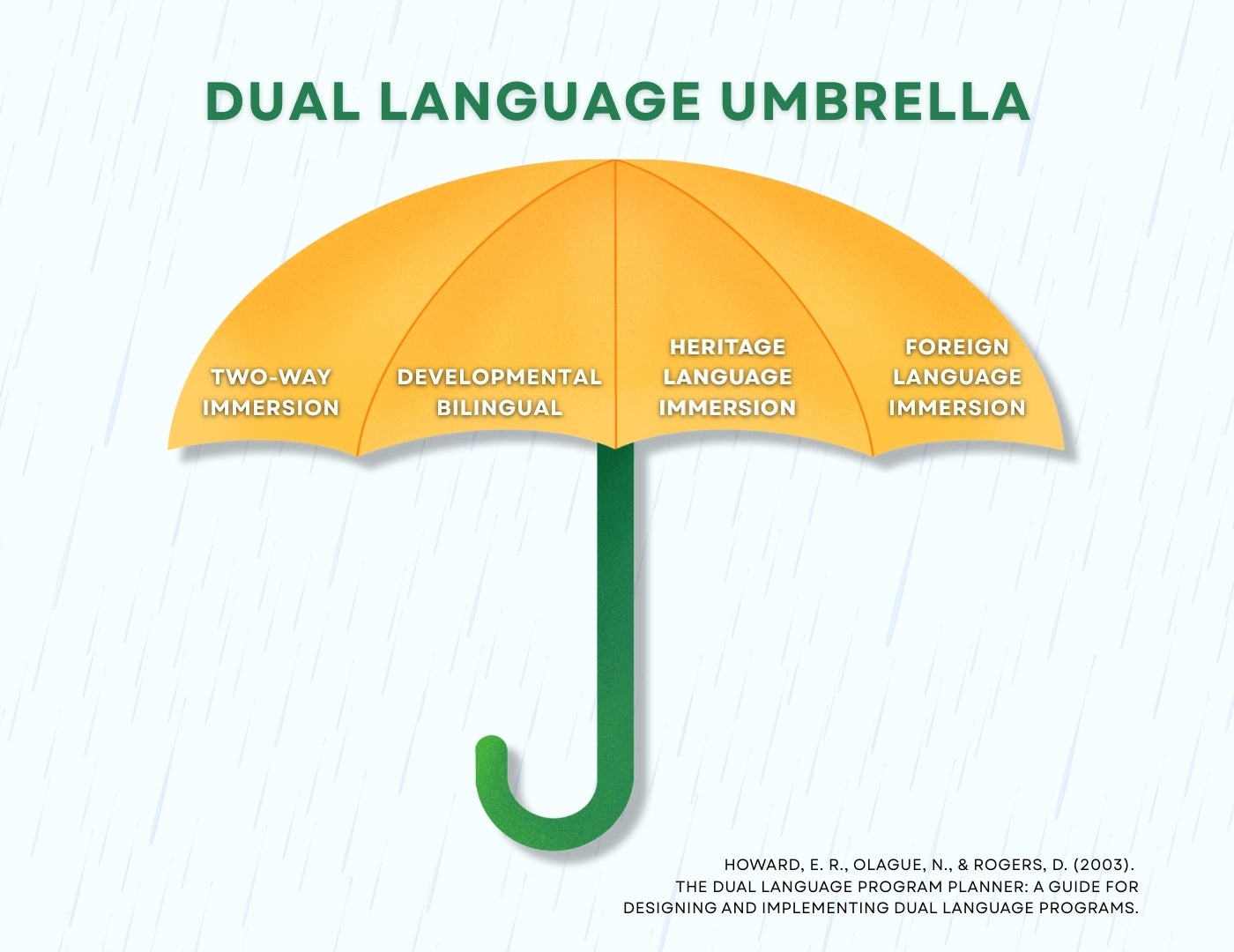
Dual language bilingual education is an umbrella term that includes multiple types of programs.
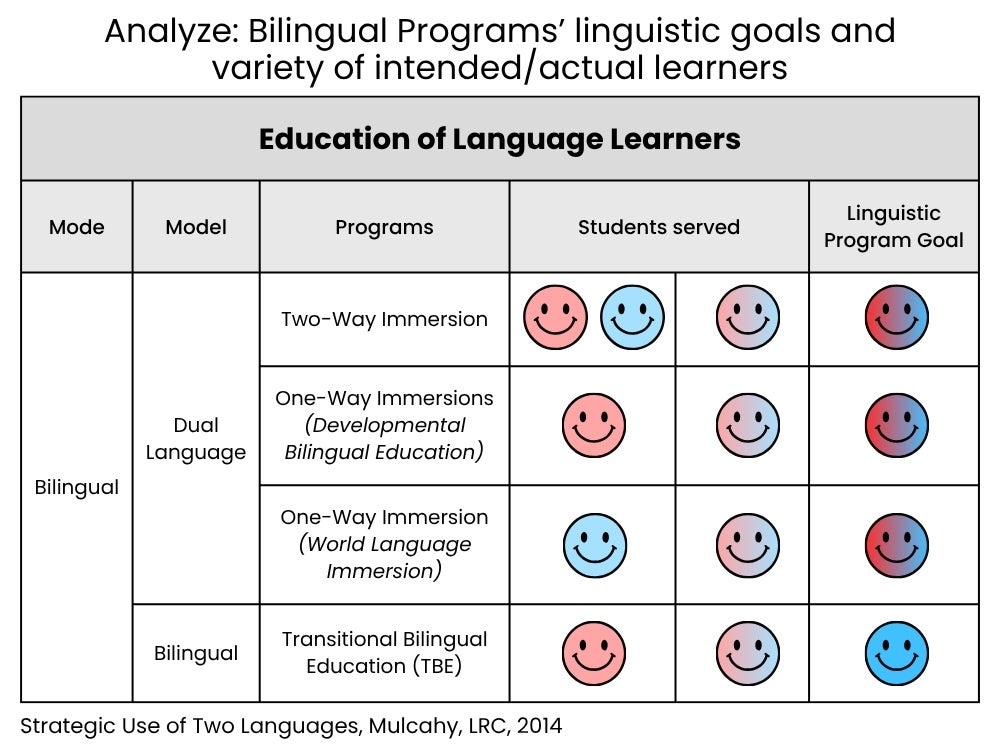
Based on the student populations they serve, their structure, and implementation, the main program models include:
Two-way dual language programs: Multilingual students who speak the partner language and their English-speaking peers are integrated to receive instruction in both English and the partner language. Other names include Two-Way Immersion (TWI) and Dual Language Immersion (DLI).
One-way dual language programs: Students from predominantly one language group receive instruction in both English and a partner language. One-way dual language programs can be:
- Programs that serve predominantly multilingual students who speak a language other than English and who are preserving and developing this home language as they learn English. These programs are also known as developmental or maintenance bilingual programs.
- Programs that serve predominantly English-speaking students who are acquiring the partner language as they continue developing their English language skills. These are also known as Foreign Language, Second Language, or World Language (WL) immersion programs.
- Programs that predominantly serve students with a family background or cultural connection to the partner language. These are also known as dual language heritage programs. In the U.S., these programs often focus on revitalizing Indigenous languages, such as Cherokee and Dane, by teaching them to heritage speakers who have shifted toward English dominance due to assimilationist pressures.
In a whole-school model, all students participate in bilingual instruction with full alignment across staffing and curriculum.
In a strand model, only a subset of students participates in the dual language program within a larger English-medium school.
- Hamayan, E. V., Genesee, F., Cloud, N., & Lindholm-Leary, K. (2013). Dual language instruction from A to Z: Practical guidance for teachers and administrators. Heinemann.
- Heiman, D., Cervantes-Soon, C., Palmer, D. K., & Dorner, L. M. (2024). Establishing a transformative foundation for dual language bilingual education: Critical consciousness at the core. The handbook of dual language bilingual education, 51-71.
- Howard, E. R., Lindholm-Leary, K. J., Rogers, D., Olague, N., Medina, J., Kennedy, B., Sugarman, J. & Christian, D. (2007). Guiding principles for dual language education. Washington, DC: Center for Applied Linguistics.
- Kim, Y. K., Hutchison, L. A., & Winsler, A. (2015). Bilingual education in the United States: An historical overview and examination of two-way immersion. Educational Review, 67(2), 236-252.
- Palmer, D. K., Cervantes-Soon, C., Dorner, L., & Heiman, D. (2019). Bilingualism, biliteracy, biculturalism, and critical consciousness for all: Proposing a fourth fundamental goal for two-way dual language education. Theory into Practice, 58(2), 121-133.
- Soltero, S. W. (2016). Dual language education. Heinemann.
What are the benefits of Dual Language Bilingual Education?
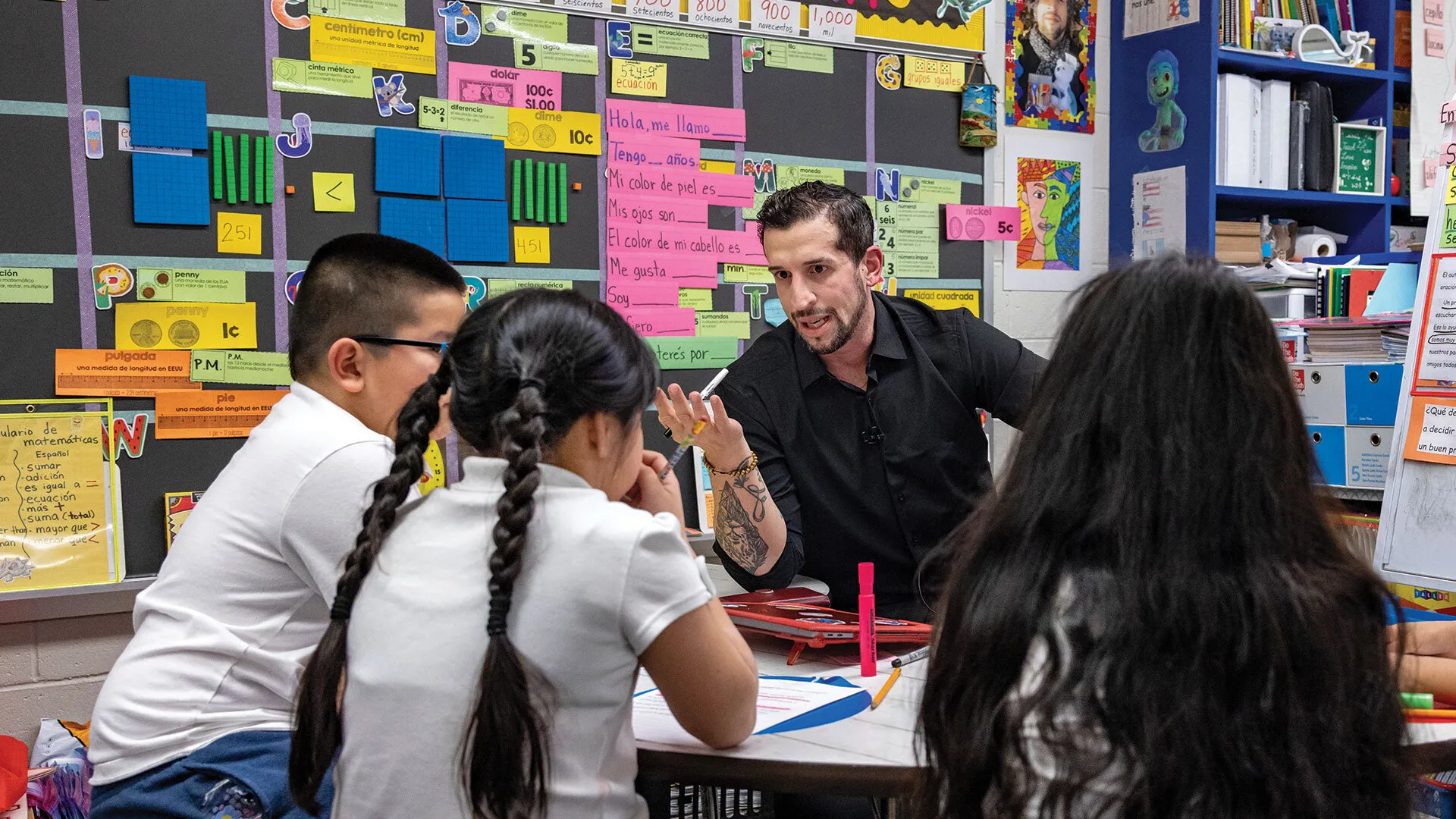
Over 30 years of research has demonstrated that dual language education programs have multiple advantages for all students, both minoritized bi-multilingual students who speak the partner language (most commonly Spanish) and English-dominant students. These advantages include:
- Improved executive control. Executive control involves a set of cognitive skills that allow individuals to exercise self-control, switch attention, plan, and use their working memory (Bialystok et al., 2014).
- Improved metalinguistic awareness; that is, the capacity to reflect on, analyze, and manipulate language as an abstract system. Metalinguistic awareness is an important factor in the development of reading among young children (Bialystok et al., 2012; 2014).
- Higher cognitive flexibility and problem-solving skills (Bialystok et al., 2001).
- Equal or higher academic achievement in literacy and math than students in English-only programs (Alanis, 2000; Collier & Thomas, 2004, 2017; Padilla et al., 2024; Rolstad et al., 2005; Steele et al., 2017; Umansky & Reardon, 2014).
- Smaller achievement gaps in reading and math between bi-multilingual students and English-dominant students (Lindholm-Leary & Block, 2010; Goodrich et al., 2021).
- Improved chances for bi-multilingual students to be reclassified out of the English Learner (EL) designation (Steele et al., 2017; Umansky & Reardon, 2014).
- Higher GPAs and enrollment in Advanced Placement (AP) classes (Morita-Mullany et al., 2020; Padilla et al., 2024).
- Improved reading, writing, and oral language skills in both English and Spanish for Spanish-speaking multilingual learners and English-dominant students, with gaps between them closing by 5th grade (Howard et al., 2004; Lindholm-Leary, 2012).
- Higher levels of English proficiency in receptive and productive language skills while maintaining their home language (Johnson & Swain, 1997; Swain & Lapkin, 1991).
- Higher early literacy English reading scores for multilingual learners in DLBE programs, which predict stronger performance in later grades (Bibler, 2021; Palacio et al., 2024; Bohlmann et al., 2025).
- Students engage in more positive cross-cultural relations (Christian et al., 1996).
- Higher levels of academic self-esteem, pride in their bilingualism, motivation, and college ambition among Latine students (Lindholm-Leary & Borsato, 1998).
- Stronger cultural and linguistic identities, self-esteem, and cross-cultural understanding (García & Kleifgen, 2018).
Research shows that immigrants who achieve high levels of bilingualism, a primary goal of dual language bilingual education programs, experience a number of benefits:
- Stronger bonds with their families (Smokowski et al., 2007).
- Less likely to be involved in at-risk behaviors and more likely to live healthy lives (Smokowski et al., 2007).
- Less likely to drop out of school (Feliciano, 2001).
- Higher employment opportunities and income, earning $2,000 to $5,000 more per year than those who only speak English (Gandara, 2015).
- More likely to go to college (Agirdag, 2014, 2015; Gandara, 2018; Rumbaut, 2014).
- Higher levels of empathy, open-mindedness, and global thinking (Dewaele & Van Oudenhoven, 2009; King & Mackey, 2009; Marcos, 1998).
- Alanís, I. (2000). A Texas two-way bilingual program: Its effects on linguistic and academic achievement. Bilingual Research Journal, 24(3), 225-248.
- Bialystok, E. (2001). Bilingualism in development: Language, literacy, and cognition. Cambridge University Press.
- Bibler, A. (2021). Dual language education and student achievement. Education Finance and Policy, 16(4), 634–658. https://doi.org/10.1162/edfp_a_00320
- Bialystok, E., Craik, F. I. M., & Luk, G. (2012). Bilingualism: Consequences for mind and brain. Trends in Cognitive Sciences, 16(4), 240–250.
- Bialystok, E., Poarch, G., Luo, L., & Craik, F. I. (2014). Effects of bilingualism and aging on executive function and working memory. Psychology and Aging, 29(3), 696.
- Bohlmann, N. L., Palacios, N., Bell, B. A., & Oh, M. H. (2025). Academic outcomes of English learners in monolingual and dual language programs. Journal of Applied Developmental Psychology, 101, 101869.
- Christian, D. (1996). Two-way immersion education: Students learning through two languages. The Modern Language Journal, 80(1), 66-76.
- Collier, V. P., & Thomas, W. P. (2004). The astounding effectiveness of dual language education for all. NABE Journal of Research and Practice, 2(1), 1-20.
- Collier, V. P., & Thomas, W. P. (2017). Validating the power of bilingual schooling: Thirty-two years of large-scale, longitudinal research. Annual Review of Applied Linguistics, 37, 203-217.
- Dewaele, J., & Van Oudenhoven, J. P. (2009). The effect of multilingualism/multiculturalism on personality: No gain without pain for Third Culture Kids? International Journal of Multilingualism, 6(4).
- Feliciano, C. (2001). The benefits of biculturalism: Exposure to immigrant culture and dropping out of school among Asian and Latino youths. Social Science Quarterly, 82(4), 865-879.
- Gandara, P. C. (2015). Is There Really a Labor Market Advantage to Being Bilingual in the U.S. ETS Research Report.
- García, O., & Kleifgen, J. A. (2018). Educating emergent bilinguals: Policies, programs, and practices for English learners. Teachers College Press.
- Goodrich, J. M., Thayer, L., & Leiva, S. (2021). Evaluating achievement gaps between monolingual and multilingual students. Educational Researcher, 50(7), 429-441.
- Howard, E. R., Lindholm-Leary, K. J., Rogers, D., Olague, N., Medina, J., Kennedy, B., Sugarman, J., & Christian, D. (2007). Guiding principles for dual language education. Washington, DC: Center for Applied Linguistics.
- Johnson, R. K., & Swain, M. (1997). Immersion Education: International Perspectives. Cambridge University Press.
- Kim, Y. K., Hutchison, L. A., & Winsler, A. (2015). Bilingual education in the United States: An historical overview and examination of two-way immersion. Educational Review, 67(2), 236-252.
- King, K., & Mackey, A. (2009). The bilingual edge: Why, when, and how to teach your child a second language. Harper Collins.
- Lindholm-Leary, K. J., & Borsato, G. (1998). Impact of Two-Way Immersion on Students’ Attitudes Toward School and College. Center for Research on Education, Diversity & Excellence.
- Lindholm-Leary, K., & Block, N. (2010). Achievement in predominantly low SES/Hispanic dual language schools. International Journal of Bilingual Education and Bilingualism, 13(1), 43-60.
- Lindholm-Leary, K. J. (2012). Success and challenges in dual language education. Theory Into Practice, 51(4), 256–262.
- Marcos, K. M. (1998). Second language learning: Everyone can benefit. The ERIC Review, 6(1), 2-5.
- Padilla, A. M., Chen, X., Swanson, E., Peterson, M., Zamora, T., & Girsky, T. (2025). Longitudinal academic, language, and social emotional learning outcomes of graduates of a one-way Spanish Immersion program. Foreign Language Annals, 58(1), 111-136.
- Palacios, N., Bohlmann, N. L., Bell, B. A., Oh, M. H., & Yue, Y. (2024). Does early elementary dual language instruction deliver as promised? AERA Open, 10.
- Rolstad, K., Mahoney, K. S., & Glass, G. V. (2005). Weighing the evidence: A meta-analysis of bilingual education in Arizona. Bilingual Research Journal, 29(1), 43-67.
- Smokowski, P. R., Chapman, M. V., & Bacalla, M. L. (2007). Acculturation risk and protective factors and mental health symptoms in immigrant Latino adolescents. Journal of Human Behavior in the Social Environment, 16(3).
- Steele, J. L., Slater, R. O., Zamarro, G., Miller, T., Li, J., Burkhauser, S., & Bacon, M. (2017). Effects of dual-language immersion programs on student achievement: Evidence from lottery data. American Educational Research Journal, 54(1_suppl), 282S-306S.
- Thomas, W. P., & Collier, V. P. (2002). A National Study of School Effectiveness for Language Minority Students’ Long-term Academic Achievement. Center for Research on Education, Diversity and Excellence.
- Umansky, I. M., & Reardon, S. F. (2014). Reclassification patterns among Latino English learner students in bilingual, dual immersion, and English immersion classrooms. American Educational Research Journal, 51(5), 879-912.
- Valentino, R. A., & Reardon, S. F. (2015). Effectiveness of four instructional programs designed to serve English learners: Variation by ethnicity and initial English proficiency. Educational Evaluation and Policy Analysis, 37(4), 612–637.
History of Bilingual Education in Maryland
To date, there is no comprehensive record of the history of dual language education programs in Maryland. Based on school district, state, community records, and journalistic account, below we provide a tentative timeline of the growth and development of these programs in the state. At the end, we outline important trends as well as challenges and opportunities.
Trends, Challenges, and Opportunities
Most bilingual education immersion programs started in two of the state’s most large, densely populated, and diverse counties, Montgomery and Prince George’s, in the 1970s and 80s. In great part these were One-Way World Language Immersion magnet programs used as a voluntary desegregation tool to attract white, middle-class families to low-income, racially segregated schools.
In the 2010s, two-way immersion / dual language immersion were opened in these two counties as a result of demographic changes and community pressures to provide linguistically and culturally affirming bilingual education to the growing number of Latinx multilingual learners.
In the last decade, four other public school districts have launched dual language immersion / two-way immersion programs.
The majority of Multilingual Learners in Maryland are still served by English language development programs, with only X% in dual language programs.
Spanish dominates as the partner language, which does not fully reflect Maryland’s linguistic diversity (Chinese, French, Tagalog, Korean, Vietnamese, Russian, etc.).
Maryland dual language and immersion programs face ongoing challenges including recruiting qualified bilingual teachers and adapting curriculum across languages.
The state currently lacks a formal bilingual or dual-language teacher certification pathway.
The Maryland Blueprint Workgroup identified seven districts with strong potential for expansion of two-way immersion programs at the elementary level.
These districts include 78 elementary schools where multilingual enrollment (30–70%) makes immersion programs feasible.
- Baltimore City Schools (2025). Building Biliteracy: John Ruhrah’s Dual Language Program Leads the Way. https://www.baltimorecityschools.org/article/2244611
- Dispoto Gumabon, A. (2025). Lakeland Dual Language Program. https://www.baltimorecityschools.org/o/lakeland/article/2282037
- College of Education, University of Maryland (2024). Bilingual Teacher Certification Testimony. education.umd.edu
- Maryland Office of Minority Health and Health Disparities. Language Diversity in Maryland. https://health.maryland.gov/mhhd/documents/language-diversity-in-maryland-infographic.pdf
- Diez (2017). Equity in immersion programs in MCPS.
- Mata-McMahon et al. (2020; 2025). Dual language program studies.
- MCPS (various reports on immersion programs).
- St. George (2016). Washington Post civil rights complaint on immersion inequity.
- Weise (2013). Mandarin immersion program history.
- Maryland State Department of Education (2022). Blueprint Workgroup report.
- Prince George’s County Public Schools. Immersion programs overview.
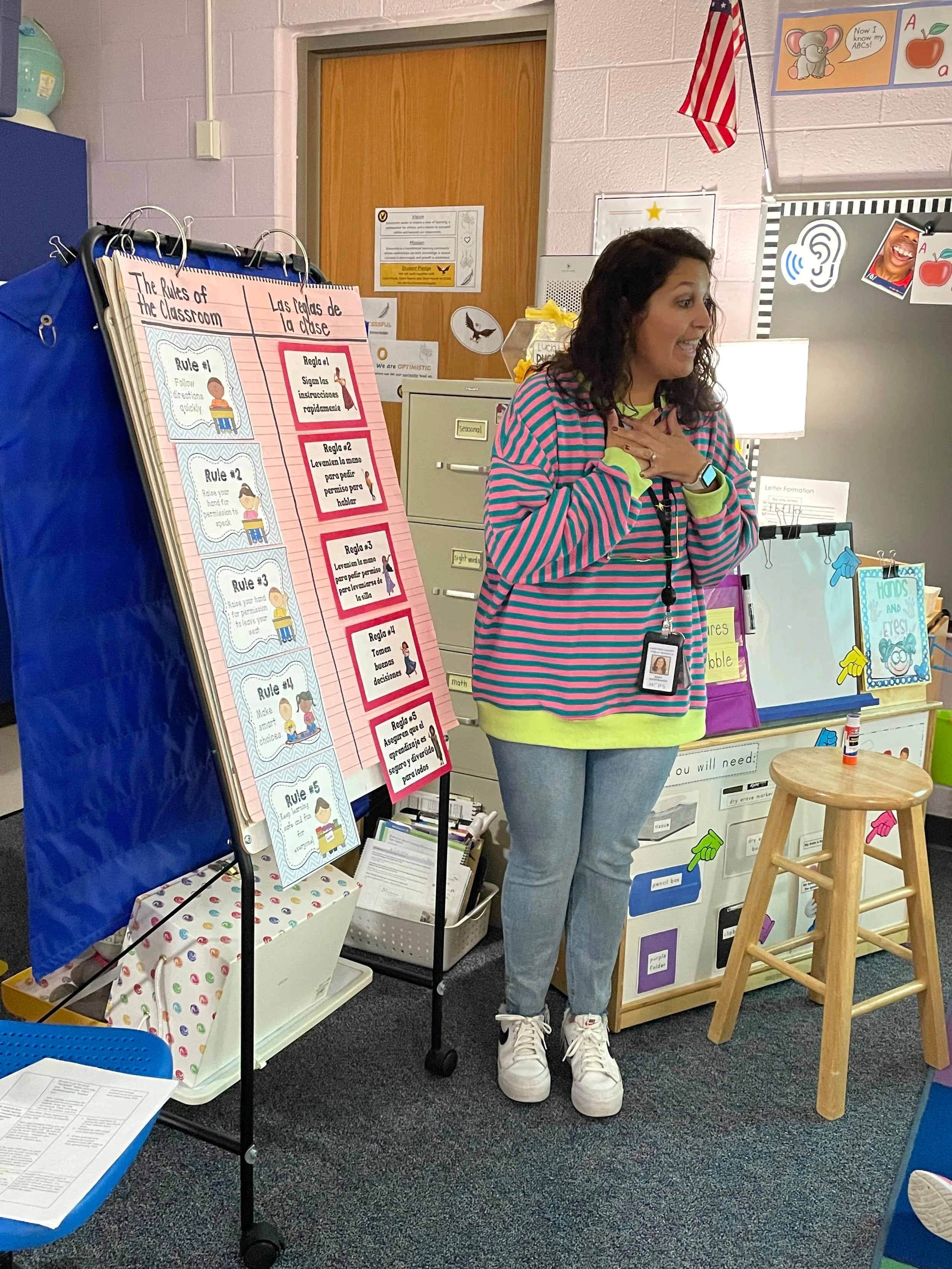
Pictured, Sara Shoemaker. Image courtesy of Harford County Public Schools.